Formula-Fed Baby Poop: What's Normal & When to Worry
14 min read
Published on 7 Aug 2026

Normal formula-fed baby poop is usually tan, yellow, or brown, and sometimes green, with a thick, peanut-butter-like consistency and a fairly strong smell. Most formula-fed babies poop once or twice a day, though anywhere from after every feeding to once every couple of days can be perfectly normal, as long as the poop is soft and your baby is feeding and growing well.
A few colors and changes are worth a call to your pediatrician, and we will get to those clearly below, but the reassuring news is that most of what shows up in your baby's diaper is completely normal. Poop is one of the main ways a baby's body tells you how digestion is going, so a little variety is expected.
This guide walks through what normal formula-fed poop looks like, what the different colors mean, how often to expect it, how to spot constipation and diarrhea, and the specific signs that mean it is time to check in with your pediatrician.
What does normal formula-fed baby poop look like?
Normal formula-fed baby poop is typically tan, yellow, or brown, with a thick, paste-like texture similar to peanut butter or hummus. It is often firmer than the loose, seedy stool of a breastfed baby, but it should not be hard. The smell is usually stronger, which is normal and comes from the way formula is digested in the gut.
In the first few days of life, all babies pass meconium, a thick, sticky, greenish-black stool that formed while your baby was still in the womb and is completely normal. Most babies pass their first meconium within a day of birth. If your baby has not passed any stool in the first 48 hours of life, let your care team know, as it is something they will want to investigate. Around day two to four, as your baby takes in more formula, their stool transitions to the lighter tan, yellow, or brown color that is typical from then on. This changeover is a good sign that your baby is feeding and digesting well.
It is worth knowing that formula-fed poop naturally differs from breastfed poop. Because formula takes a little longer to digest, formula-fed stools tend to be firmer and more strongly scented than breastfed stools. The frequency of stooling is a little more nuanced. In the first two months, breastfed babies usually poop more often than formula-fed babies. After that it often flips: many breastfed babies start pooping much less often, sometimes only once or twice a week, while formula-fed babies tend to keep having daily bowel movements. This is because breastmilk is efficiently absorbed and leaves very little waste behind. Both patterns are completely normal; they simply reflect the different ways the two are digested.
“Your pediatrician will often ask you about the appearance and frequency of your baby’s poop, but there is a wide range of what is considered normal. If you are obsessing over your baby’s poop, you are not alone, but you should feel reassured if your baby is continuing to feed comfortably and pass soft, non-bloody poops.“ - Alexis Berkovits, MD
What do different baby poop colors mean?
Baby poop comes in a surprising range of colors, and most of them are normal. The table below covers the common ones for formula-fed babies, along with the few that are worth a call to your pediatrician.
|
Color |
Common cause |
Normal, or call your pediatrician? |
| Yellow or orange | Typical formula digestion | Normal |
| Tan or brown | Typical formula-fed stool | Normal |
| Green | Iron-fortified formula or faster digestion | Usually normal |
| Greenish-black, tarry (first days) | Meconium | Normal in the first few days |
| Black (after day 4 or 5) | Possible blood in the stool | Call your pediatrician |
| Red or bloody | Several possible causes | Call your pediatrician |
| White, pale, or chalky gray | Rare, but can signal a liver, gallbladder, or bile duct issue | Call your pediatrician |
| Persistent mucus (slimy, jelly-like) | Possible allergy or infection | Call your pediatrician |
The color that worries parents most is green, so it is worth saying plainly: green poop in a formula-fed baby is usually completely normal. It most often comes from the iron in iron-fortified formula, which is an important nutrient for your baby, or simply from nutrients moving through the digestive tract a little faster than usual. As long as your baby is feeding well and is otherwise happy, green stool on its own is not a cause for concern.
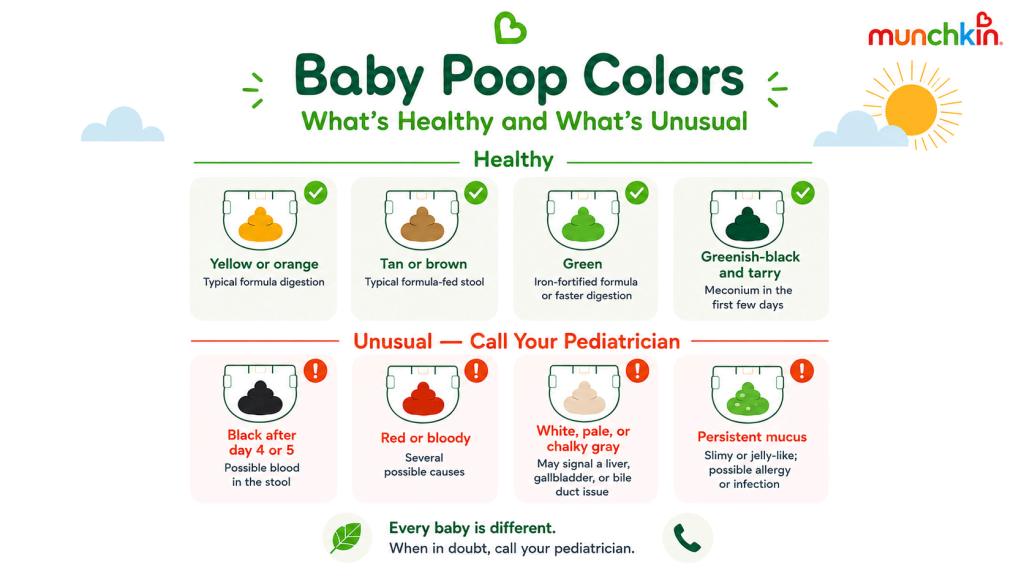
That said, the colors in the "call your pediatrician" column are worth acting on. However, they do not automatically mean something is wrong. For example, red can come from something as minor as a swallowed bit of blood from a cracked nipple. Just remember that red, black, white, and gray are the shades your pediatrician will want to check rather than guess at.
How often should a formula-fed baby poop?
There is no magic number for how often a formula-fed baby should poop. Many go once or twice a day, but anywhere from after every feeding to once every couple of days can be perfectly normal. What matters far more than the count is that the stool stays soft and your baby is feeding, growing, and seeming comfortable.
Formula-fed babies often poop a little less frequently than breastfed babies, especially in the first 2 months of life, because formula takes slightly longer to digest. As your baby grows, their pattern will usually settle and may slow down, much like their feeding rhythm does. That is all part of normal development.
What is worth keeping an eye out for is the combination of infrequent pooping with hard, dry, pellet-like poop, a firm belly, a baby who seems genuinely uncomfortable, or visible blood, which points more toward constipation, which we cover next.
What does constipation look like in a formula-fed baby?
True constipation is more about the texture of the stool, rather than how often it comes. A formula-fed baby who is constipated will pass hard, dry, pellet-like poop, sometimes described as looking like little pebbles. Going a day or two between soft poops is not constipation, but hard stool that seems difficult or uncomfortable to pass is.
Signs that may point to constipation include:
-
- Hard, dry, or pellet-like stool
- A firm, tight belly
- Crying or straining hard for more than 10 minutes without passing anything
- Poop that seems hard or painful to pass
- Blood in the poop, typically from a tiny tear in the skin lining the anus
It helps to know that straining is not the same as constipation. Many babies grunt, go red in the face, cry, and strain before pooping, then pass a perfectly soft stool. This is a normal stage called infant dyschezia, where a baby is still learning to coordinate the muscles involved in pooping. If the result is soft, that straining is nothing to worry about.
If you think your baby is genuinely constipated, talk to your pediatrician rather than changing formula or trying remedies on your own. Constipation can sometimes relate to how formula is prepared, so it is always worth double-checking that you are mixing it with the correct amount of water. If you ever see blood in your baby's stool, even a small streak, let your pediatrician know rather than assuming it is just from straining. If you are worried about constipation or dehydration in a baby less than 6 months old, do not give plain water or add extra water to formula without consulting your doctor first because it can be dangerous. Your pediatrician can confirm what is going on and provide safe, age-appropriate recommendations for your baby.
What does diarrhea look like, and why does it happen?
Diarrhea in a formula-fed baby looks very different from their usual paste-like stool. It is watery or runny, often occurs more frequently than normal, and tends to soak into the diaper rather than holding its shape. There may also be a stronger smell or some mucus. Causes include a viral infection, a stomach bug, or a food sensitivity.
The main concern with diarrhea is not the mess but the risk of dehydration, since babies can lose fluid quickly. Keep an eye out for very few (fewer than 4 in 24 hours) wet diapers, dry mouth or lips, no tears when crying, a sunken soft spot on the head, or unusual sleepiness. Dehydration can develop quickly in a young baby, so call your pediatrician promptly if you notice these. Because a stomach bug can also bring on a fever, one important safety point: in a baby 8 weeks old or younger, a rectal temperature of 100.4°F (38°C) or higher should be evaluated in an emergency department right away, even if your baby otherwise seems fine. In older babies, call your pediatrician if a fever comes along with the diarrhea. When in doubt, it is always worth a call.
When should you call the pediatrician about your baby's poop?
Most changes in your baby's poop are normal, but a few are worth a call to your pediatrician. Reach out if you notice any of the following:
- Red streaks or blood in the poop
- Black poop after the first several days of life, once meconium has passed
- White, pale, or chalky gray poop, which is rare but can signal a problem
- Hard, dry, pellet-like poop, or a firm, tight belly
- Very watery, frequent poop, or any signs of dehydration such as few or no wet diapers, a dry mouth, no tears, or unusual sleepiness
- Persistent mucus in the poop
- Any poop change that comes with a fever, vomiting, poor feeding, or a baby who seems unwell or in pain
None of these automatically mean something is seriously wrong. Many have simple explanations, but they are the signs your pediatrician will want to evaluate rather than have you guess about. If poop changes keep happening alongside other symptoms, such as eczema, poor weight gain, or a lot of fussiness, your pediatrician can also check whether something like a food insensitivity or allergy might be involved, and guide you on what to do next.
Above all, trust your instincts. You know your baby better than anyone, and if something feels off, even if it is not on this list, it is always okay to reach out. Pediatric offices field questions about baby poop every single day, and no one will mind you checking.
”If you are ever questioning the appearance of your baby’s poop, remember that it is always a great idea to take a picture to share with your pediatrician!” - Alexis Berkovits, MD
A note on formula and your baby's digestion
Your baby's poop is really just a window into how they are digesting their formula, and every baby settles into their own normal. Most of the variety you will see is exactly that, variety, not a problem. If you are still choosing a formula or want to understand what goes into one, our guides on how to choose a baby formula and what baby formula is made of , walk through the essentials, and your pediatrician is always the best guide for anything specific to your baby.
Frequently asked questions
Why does my formula-fed baby's poop smell so strong?
A stronger, more adult-like smell is normal for formula-fed babies. Formula is digested differently from breastmilk and encourages different bacteria in the gut, which gives the stool a more noticeable odor. On its own, a strong smell is not a sign of a problem.
Is it normal for a formula-fed baby to poop after every feeding?
Yes. Some babies poop after nearly every feeding, especially in the early weeks, thanks to a natural reflex that gets the bowels moving when the stomach fills. As long as the stool is soft and your baby is comfortable and growing well, frequent pooping is not a concern.
Should formula-fed baby poop be seedy like breastfed poop?
Usually not, but it can happen. Seedy stool is more typical of breastfed babies, and formula-fed poop is generally smoother and thicker, more like peanut butter. That said, those little "seeds" are just undigested milk fat, so they can show up in formula-fed babies too, especially in the early weeks when the gut is still maturing. And because many babies are combination-fed, a mix of textures and colors is common and normal.
Does the iron in formula cause constipation?
No. This is a common worry, but the amount of iron in iron-fortified formula does not cause constipation, and iron is an important nutrient for your baby's development. Iron can turn stool darker or greenish, which is harmless. If your baby is constipated, the cause is usually something else, so it is worth checking with your pediatrician rather than switching to a low-iron formula.
Can switching formula change your baby's poop?
Yes. A different protein or fat blend can change the color, smell, and texture of your baby's stool, and it can take a week or two for their system to adjust to a new formula. If you are thinking about switching, especially for digestive reasons, talk to your pediatrician first rather than changing on your own.
This article is for general informational and educational purposes only and is not intended as medical advice, and it is not a substitute for professional evaluation by your pediatrician or another qualified healthcare provider. The descriptions of normal and concerning stool are general guidance and cannot account for your individual baby. You know your baby best, so if you notice any of the warning signs described above, or if something simply feels off, contact your pediatrician. This is especially important for newborns, babies born prematurely, and babies with any underlying health condition. When in doubt about your baby's poop, health, or feeding, always reach out to your healthcare provider.
References
- American Academy of Pediatrics, HealthyChildren.org, infant formula feeding, iron-fortified formula, and newborn fever guidance — https://www.healthychildren.org
- Children's Hospital Colorado, Baby Poop Guide — https://www.childrenscolorado.org/just-ask-childrens/articles/baby-poop-guide/
- Children's Hospital of Orange County (CHOC), Your Child's Poop: An Ultimate Guide — https://health.choc.org/your-childs-poop-an-ultimate-guide/
- Johns Hopkins Medicine, Stool Color Guide — https://www.hopkinsmedicine.org/health/conditions-and-diseases/stool-color-guide
- Akron Children's, Decoding Baby Poop Colors — https://www.akronchildrens.org/inside/2026/03/09/inside-babys-diaper-decoding-infant-stool-colors/
- Nationwide Children's, Newborn Poop: Meconium and Beyond — https://www.nationwidechildrens.org/family-resources-education/700childrens/2021/07/newborn-poop-meconium
- Centers for Disease Control and Prevention, Infant Formula Preparation and Storage — https://www.cdc.gov/infant-toddler-nutrition/formula-feeding/preparation-and-storage.html

Dr. Alexis Berkovits
Pediatrician