8 Toddler Learning Activities for Colors, Counting, and Shapes
10 min read
Published on 5 Nov 2026
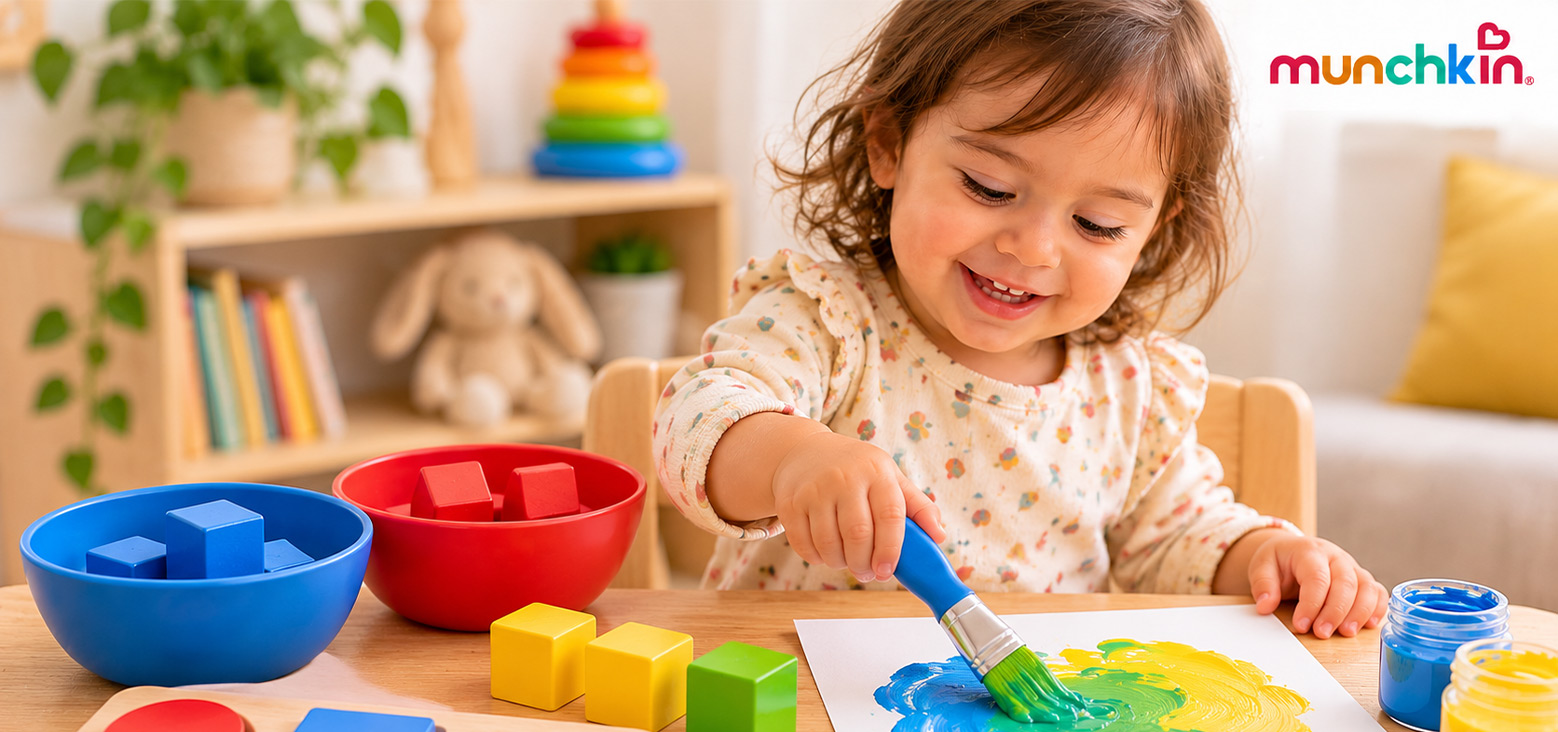
Toddler learning activities can introduce colors, counting, and shapes through simple games such as sorting blocks, counting snacks, and spotting circles around the room. You can bring these ideas into everyday play with familiar cups, plates, and toys, without worksheets or complicated setup.
The eight activities below include suggested ages, materials, and easy adaptations so you can follow your child’s interests and keep play relaxed.
What is play-based learning?
Play-based learning for toddlers introduces ideas through hands-on exploration, everyday games, and conversations with you. Your child might compare blocks, match colors, or hear number words as you count together.
ZERO TO THREE’s early math guidance recommends exploring counting, sorting, size, and patterns through daily routines.
Follow your child’s interests, describe their actions, and demonstrate one small step. Give them time to explore without requiring correct answers.
What to focus on by age
When teaching toddlers colors and numbers, adjust the activity to what your child can do today. Use these suggestions to simplify or extend play.
- Age 1: Explore large, age-appropriate toys together. Name a color or shape while your child handles an object, without expecting them to repeat it.
- Age 2: Offer two contrasting colors for matching and model counting a few objects. Let your child watch, point, or join in.
- Age 3: Try familiar sorting games with more choices. Compare objects using words such as “same,” “different,” “big,” and “small.”
- Age 4: Add a challenge when your child is interested. Sort blocks by color, then invite them to sort the same blocks by shape.
For developmental context, the CDC lists recognizing at least one color at 30 months and naming a few colors at 4 years. Recognizing and naming colors are separate skills.
Suggested ages are starting points for adapting these learning activities for toddlers, not milestones for mastering each game. Follow product age labels and consider your child’s abilities and tendency to mouth objects.
Choose play materials without small or detachable parts, following the AAP’s toy safety guidance. Supervise each activity and put materials away afterward.
This article provides general educational information and does not replace advice from your child’s healthcare professional. Talk with your pediatrician about missed developmental milestones, loss of skills, or other concerns.
Color learning activities
Begin with two contrasting colors and familiar objects. Name the colors as your child looks, points, or matches.
Suggested ages are starting points for adapting these learning activities for toddlers, not milestones for mastering each game. Follow product age labels and consider your child’s abilities and tendency to mouth objects.
Choose play materials without small or detachable parts, following the AAP’s toy safety guidance. Supervise each activity and put materials away afterward.
1. Color sorting with cups
Suggested starting age: Around 18 months, with adult help
Skill: Color matching and sorting
Materials: Two wide cups or bowls and large, age-appropriate blocks in two colors that fit comfortably inside them
Place a blue block in one bowl and a red block in the other. Show your child how to match another blue block to the blue example.
Invite them to place the remaining blocks. If they prefer filling and emptying the bowls, name the colors as they play.
Easy adaptation: Offer just two matching blocks at first. Add another color when your child enjoys matching the first two.
2. Indoor color hunt
Suggested starting age: Around 2 years
Skill: Noticing colors and using color words
Materials: Familiar objects within easy reach
Choose one color and point to an example: “Your toy car is red.” Invite your child to find another red object nearby.
Look around the room together, letting your child point to matching objects. Name what they notice: “You found a red cushion.”
Easy adaptation: Place one red object and one blue object beside your red example. Help your child look for the matching color, keeping everything within easy reach.
3. Two-color paint mixing
Suggested starting age: Around 2½ years, depending on readiness
Skill: Observing and describing color changes
Materials: Age-appropriate washable, nontoxic paint, paper, and a broad brush
Place a little blue and yellow paint beside each other on the paper. Show your child how to mix them, saying, “The blue and yellow are making green.”
Let your child brush and mix at their own pace. Describe the streaks and patches of color appearing on the paper.
Easy adaptation: Offer an age-appropriate brush with a larger handle if the original brush is difficult to hold.
Safety note: Follow the paint’s age and use instructions. Nontoxic paint is not intended for eating, so stop if your child mouths the paint or brush.
Counting and number activities
Introduce counting by pairing one number word with one object or action. Start with a small group and let your child listen, point, or count alongside you.
4. Count the snacks
Suggested starting age: Around 18 months, with adult modeling
Skill: Connecting number words with objects
Materials: A divided plate or ordinary plate and familiar foods prepared to a suitable shape, size, and texture for your child’s eating abilities
Before eating begins, place three soft pieces of a familiar food, such as cooked sweet potato, on the plate. Point to each once: “One, two, three. Three pieces.”
Keep the counting brief and optional. Let your child eat without needing to count, name a number, or finish the pieces.
Easy adaptation: Start with one piece, then add a second and count both together.
Safety note: Keep your child seated upright and supervise eating. Follow CDC choking-prevention guidance when preparing food; softness alone does not establish a suitable shape or size.
5. Scoop and count
Suggested starting age: Around 2 years
Skill: Counting and coordinating hand movements
Materials: Two bowls, a broad scoop, and large, age-appropriate blocks that the scoop can comfortably hold
Place three blocks in one bowl. Demonstrate moving one block at a time into the empty bowl, saying a number with each transfer.
Let your child try while you count alongside them. If several blocks move together, separate them in the bowl before counting each one.
Easy adaptation: Transfer the blocks by hand if the scoop is difficult to use.
Safety note: Avoid beads, dried beans, and other small loose fillers.
6. Count steps or claps
Suggested starting age: Around 2 years
Skill: Connecting number words with actions
Materials: A clear, level walking space, or none for clapping
On a clear, level floor, walk beside your child and count three steps aloud, saying one number with each step. Pause before repeating.
For a seated version, clap slowly together while counting each clap. Let your child choose whether to walk, clap, or watch you demonstrate.
Easy adaptation: Stay seated and count one or two claps together.
Shape and sorting activities
Introduce shapes by matching pieces and noticing familiar outlines around your home.
7. Match the shapes
Suggested starting age: Around 18 months, with adult help
Skill: Shape matching and problem-solving
Materials: An age-rated shape sorter or toddler puzzle with large pieces
Offer one piece and show its matching opening. Say, “This circle fits here,” then let your child try placing it.
Give them time to turn the piece and try again. If they become frustrated, demonstrate slowly or offer help without taking over.
Easy adaptation: Begin with one piece and one opening. Offer two contrasting shapes when your child wants more choices.
8. Everyday shape hunt
Suggested starting age: Around 2½ years
Skill: Noticing and comparing shapes
Materials: Familiar household objects
Point to a circular plate and trace its edge, saying, “The edge of this plate makes a circle.” Look for another circular outline, such as a clock face.
Let your child point while you name the shapes. Choose clear examples, such as a square tile, rather than objects with complicated outlines.
Easy adaptation: Start with one shape. For an interested older child, compare two circles of different sizes.
Safety note: Observe objects where they are. Keep heavy, breakable, or out-of-reach items for looking rather than handling.
Turning mealtime into learning time
Mealtime setup offers opportunities to talk about colors, shapes, and quantities. Before serving food, place one spoon beside each plate or name the color of your child’s cup.
Use familiar tableware, including Munchkin® divided plates, bowls, and cups, for these educational activities for toddlers. Name a color or compare shapes while setting the table together.
Once eating begins, let your child focus on their food without quizzes, counting demands, or pressure to finish.
Frequently asked questions
Can my toddler recite numbers without understanding quantities?
Yes. Saying number words in sequence differs from counting objects and understanding the total. Stanford’s early math guidance explains that counting involves several connected skills, which children develop through experience.
Can I introduce colors and numbers in two languages?
Yes. Use the languages you speak comfortably during play and daily routines. The AAP’s multilingual guidance explains that learning multiple languages does not cause speech or language disorders. Discuss concerns with your child’s healthcare professional.
Should my toddler share materials during learning games?
Offer separate materials when possible rather than requiring sharing throughout the activity. ZERO TO THREE recommends opportunities for side-by-side play without frequent turn-taking demands. You can model taking turns when both children are willing.
How can siblings join without making the activity too difficult?
Give each child a different role in the same game. An older sibling might find three blue objects while your toddler matches two blocks. Keep small materials intended for older children out of your toddler’s reach.
References
- ZERO TO THREE, Help Your Child Develop Early Math Skills - https://www.zerotothree.org/resource/help-your-child-develop-early-math-skills/
- Centers for Disease Control and Prevention, Milestones by 30 Months - https://www.cdc.gov/act-early/milestones/30-months.html
- Centers for Disease Control and Prevention, Milestones by 4 Years - https://www.cdc.gov/act-early/milestones/4-years.html
- American Academy of Pediatrics, How to Buy Safe Toys - https://www.healthychildren.org/English/safety-prevention/at-home/Pages/how-to-buy-safe-toys.aspx
- Stanford University, DREME Teacher Educator, What Children Know and Need to Learn About Counting - https://prek-math-te.stanford.edu/counting/what-children-know-and-need-learn-about-counting
- American Academy of Pediatrics, Young Children Learning Multiple Languages: Parent FAQs - https://www.healthychildren.org/English/ages-stages/gradeschool/school/Pages/7-Myths-Facts-Bilingual-Children-Learning-Language.aspx
- ZERO TO THREE, Tuning In: Supporting Sharing - https://www.zerotothree.org/resource/tuning-in-supporting-sharing/
Munchkin