What Is Baby Formula Made Of? A Parent's Ingredient Guide
11 min read
Published on 21 Jul 2026
Baby formula is made of a milk base, most often cow's milk, plus added fats, carbohydrates, vitamins, minerals, and nutrients chosen to bring it closer to breastmilk.* The cow's milk gets modified first, because on its own it is too hard for a newborn to digest. And every formula sold in the US has to clear the same strict FDA nutrient and safety standards, so whatever ends up on the shelf is built to be a complete meal for your baby.
If you have ever stood in the kitchen at 2am, turned the can around, and wondered what half of those ingredients actually are, you are not overthinking it. The list looks dense. But there is a reason behind every line on it.
Here is what really goes in the can, what each part does for your baby, which ingredients bring a formula closer to breastmilk, and how to read a label without second-guessing yourself.
What ingredients are in baby formula?
The main ingredient in most baby formulas is cow's milk, or more precisely, the protein in cow's milk. Straight from the carton it is too high in casein and too tough for a baby to break down, so formula makers modify it to be gentler and closer to breastmilk before it ever becomes the base of a formula.
That protein comes in two forms: whey and casein. Whey is the lighter, faster-digesting one. Casein is the slower, heavier one. Breastmilk leans naturally toward whey, so formula makers tip the ratio the same way to go easier on a small stomach. It is one of the biggest reasons one formula can feel gentler than another, and it is why so many first-stage formulas are described as whey-dominant.
Why does protein get so much attention? Because it is the raw material your baby is built from. That first year is the fastest growth a human ever goes through, and protein is what fuels it: the muscle, the organs, the skin, all of it. Formula is regulated to hit the right amount for this stage, enough to support that growth, without the excess you would get from plain cow's milk.
Not every formula sticks to standard cow's milk protein, though. Some are built on modified or alternative proteins for babies with particular needs:
- Partially hydrolyzed protein: cow's milk protein broken into smaller pieces for easier digestion and general tummy comfort.
- Extensively hydrolyzed protein: broken down further, used for cow's milk protein allergy under a pediatrician's guidance.
- Soy protein: the only plant-based base approved for use in the US, chosen for specific dietary needs.
- Goat milk protein: a newer option in the US that some parents prefer, though it is not suitable for babies with a cow's milk allergy.
- Amino acid-based: the simplest protein form, used for severe allergies or medical conditions under medical supervision.
For most healthy, full-term babies, a standard cow's milk formula is the right place to start. If your little one seems uncomfortable after feeds, your pediatrician can help you figure out whether a different protein is worth trying.
The ingredients that make formula closer to breastmilk
Once you get past the basic building blocks, the ingredients that really separate one formula from another are the ones added to bring it closer to breastmilk.* These are the nutrients researchers have spent decades studying and recreating, and they are usually where a premium formula pulls ahead of a standard one. Here is what they are, and what each one is doing for your baby.
|
Ingredient |
What it does for your baby |
| DHA and ARA | Fatty acids that support brain and eye development |
| Alpha-lactalbumin | A gentle, high-quality whey protein abundant in breastmilk |
| Lactoferrin | A breastmilk protein associated with natural immune support |
| Beta-palmitate (sn-2 palmitate) | A fat structured to help support digestion and nutrient absorption |
| Prebiotics (GOS and FOS) | Feed the healthy bacteria in a baby's gut |
| Nucleotides | Help support immune development |
| Taurine, lutein, L-carnitine, beta-carotene | Round out the breastmilk-inspired nutrient profile |
Structure and levels differ from those in breastmilk.
A few of these deserve a closer look, because they are doing the most to close the gap with breastmilk. DHA and ARA are fatty acids found in breastmilk that support brain and eye development, and they now show up in nearly every modern formula. Alpha-lactalbumin is a whey protein that breastmilk is especially rich in, valued for being gentle and high quality. Lactoferrin is another breastmilk protein, this one associated with a baby's natural immune defenses.
Beta-palmitate, sometimes written as sn-2 palmitate, is one of the more sophisticated additions. It is a fat arranged the same way it naturally appears in mature breastmilk, and that specific structure helps support gentler digestion, softer stools, and the absorption of nutrients like calcium. Most formulas skip it, which is part of what makes it a signal that a formula was designed closely around breastmilk.
Does baby formula contain lactose or corn syrup?
The main carbohydrate in formula is usually lactose, the same natural sugar found in breastmilk. Some formulas use corn syrup or corn syrup solids instead, often in specialized or hydrolyzed products where the milk sugar has been reduced. This one is worth understanding when you read a label: corn syrup solids are an FDA-permitted carbohydrate source, and they are not the same thing as high-fructose corn syrup, which is not used in US infant formula at all. Still, lactose is the carbohydrate closest to what a baby gets from breastmilk, which is why a lot of parents look for it listed first.
No formula sets out to replace breastmilk, which is recommended as the best source of nutrition for most babies. The best ones are designed to be inspired by it instead, getting as close as the science allows while delivering complete, safe nutrition for the times you choose to formula-feed or need an alternative. That is the whole point of the ingredients above. Not to copy breastmilk, but to come closer to it. The right formula supports your feeding journey, whether that looks like breast, bottle, or both.
What are the different types of baby formula?
There are five main types of baby formula: cow's milk-based, soy-based, goat milk-based, hydrolyzed, and amino acid-based. Most are grouped by the protein they are built around, and the one you land on usually comes down to your baby's needs. For most healthy, full-term babies, a standard cow's milk-based formula is the recommended starting point. The rest exist for specific situations, and a few are only used under a pediatrician's guidance.
Cow's milk-based formula is the most common type and works well for the majority of babies. The cow's milk protein is modified to be gentler and closer to breastmilk, as covered above.
Soy-based formula is the only plant-based formula approved for use in the US. It is generally chosen for specific dietary needs, like a baby who cannot have dairy, and is best used after a conversation with your pediatrician.
Goat milk-based formula is a newer option in the US that some parents prefer. Because goat milk protein is similar to cow's milk protein, it is not a safe choice for babies with a diagnosed cow's milk allergy.
Hydrolyzed formulas use protein that has been broken down into smaller pieces so it is easier to digest. Partially hydrolyzed formula is meant for general digestive comfort, while extensively hydrolyzed formula is used for cow's milk protein allergy under medical guidance.
Amino acid-based formula uses the simplest form of protein and is reserved for babies with severe allergies or specific medical conditions, always under a pediatrician's supervision.
If the baby seems uncomfortable after feeding, with a lot of fussiness, gas, or unusually loose stools, the urge to switch formulas on your own is real. Talk to your pediatrician first. They know your baby's history and can help you decide whether a different type is actually the right move, since plenty of babies settle on a standard formula given a little time. For a fuller breakdown of how the different formulas compare, see our guide to the different types of infant formula.
How Munchkin makes its infant formula
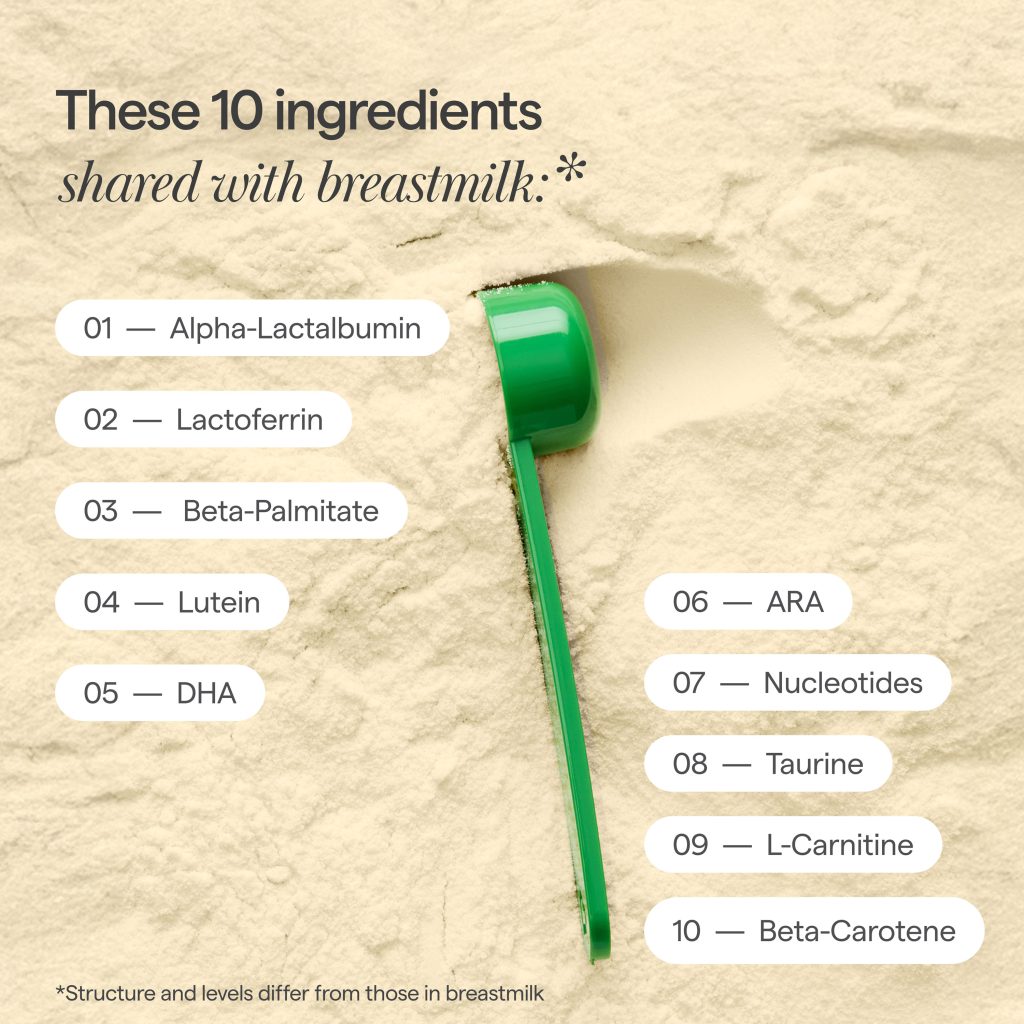
Munchkin built its Infant Formula around the same goal behind every ingredient above: getting as close to breastmilk as the science allows.* Its patented Nurture 10 Blend shares 10 ingredients with breastmilk,* and it was developed over a decade of research rather than rushed to market.
Those 10 ingredients include the ones doing the most to close the gap with breastmilk: alpha-lactalbumin and lactoferrin, the gentle, immune-supporting proteins found in breastmilk, along with DHA, ARA, lutein, nucleotides, taurine, L-carnitine, and beta-carotene. It is also the only US cow's milk formula fortified with beta-palmitate, the breastmilk fat structured to help support digestion and nutrient absorption. Munchkin offers the Nurture 10 Blend in two options: Munchkin Infant Formula with Original Milk and Munchkin Infant Formula with Organic Milk, made with USDA-certified organic milk from grass-fed New Zealand cows.
What sets the formula apart is not just what goes in, but the proof behind it. Munchkin Infant Formula is clinically studied, with its formulation supported by a body of peer-reviewed research, and it is made in a state-of-the-art facility in Canada that is audited by both the US FDA and the Canadian Food Inspection Agency. Every batch is tested for heavy metals and for pathogens, including the bacteria responsible for infant botulism, before it is released. You can dig into the full clinical trial and the science behind each ingredient at Munchkin's Clinical Nutrition Hub. For parents who read labels closely and want to know exactly what they are feeding their baby, that combination of breastmilk-inspired ingredients and rigorous testing is the whole point.
Choosing a formula you can feel good about
Understanding what goes into formula is the first step to choosing one with confidence. Once you know the milk base, the protein ratio, the carbohydrate, and the breastmilk-inspired nutrients each have a job to do, a label stops feeling intimidating and starts being genuinely useful. Look for lactose listed ahead of corn syrup, check that the formula is iron-fortified, scan for DHA, ARA, and a fuller breastmilk-inspired blend, and look for trusted third-party testing like the Clean Label Project.
Whatever you land on, the best formula is the one that works for your baby and fits your family. Breastmilk, formula, or a mix of both, every feeding journey is a good one. And for the calls that go beyond the label, especially if your baby has digestive or allergy concerns, your pediatrician is always the right partner. When you are ready to compare options, you can explore the full Munchkin Infant Formula range.
Frequently asked questions
Why is iron added to baby formula?
Iron supports healthy blood and brain development in the first year, when babies need more of it than their bodies store at birth. Most US formulas are iron-fortified, which is what pediatricians recommend for the majority of formula-fed babies.
Is homemade baby formula safe?
No. The FDA advises against homemade infant formula because it carries serious risks of contamination and nutritional gaps. Commercial formula is built to deliver a precise balance of nutrients that is very difficult to replicate safely at home.
What is the difference between formula and breastmilk?
Breastmilk is recommended as the best source of nutrition for most babies. Formula is designed to be inspired by breastmilk and to provide complete, safe nutrition when you formula-feed, though its structure and levels differ from those in breastmilk.
Are all baby formulas held to the same safety standard?
Yes. Every infant formula sold in the US, whether a store brand or a premium brand, must meet the same FDA requirements for nutrients and safety before it reaches the shelf.
This article is for general informational and educational purposes only and is not intended as medical advice. Breastfeeding is recommended as the best source of nutrition for most infants. Always consult your pediatrician or a qualified healthcare professional before making decisions about your baby's feeding, including choosing or changing an infant formula. Structure and levels of ingredients shared with breastmilk differ from those in breastmilk.
Munchkin