Why Choose Organic Formula? What Parents Should Consider
12 min read
Published on 10 Aug 2026
Parents may choose organic formula because they value certified ingredient sourcing, non-GMO production standards, and USDA requirements for how dairy and other agricultural ingredients are produced.
Organic formula can be a reasonable choice for families who prioritize those production practices, but organic certification is not required for safe or complete infant nutrition. All infant formulas legally sold in the United States must meet FDA requirements for safety and nutritional adequacy.
This guide covers what the organic label means, how organic and conventional formulas differ, and how to decide whether the added cost fits your family’s priorities.
What Does “Organic” Mean for Baby Formula?
Organic baby formula is made with agricultural ingredients that meet USDA standards for how they are produced, processed, handled, and labeled. The term describes ingredient sourcing and production. It does not automatically mean the formula is more nutritious, easier to digest, or suitable for every baby.
USDA organic standards generally require:
- Prohibition of genetic engineering
- Restrictions on most synthetic pesticides and fertilizers
- Organic feed for certified dairy animals
- Prohibition of antibiotics and growth hormones in certified-organic livestock production
- Compliance with federal processing and labeling rules
Organic does not mean that no pesticides or fertilizers were used. Certain substances are permitted under the USDA’s National List of Allowed and Prohibited Substances.
The label also matters:
- Organic: At least 95% of ingredients are certified organic, excluding water and salt. The product may display the USDA Organic seal.
- Made with organic: At least 70% of qualifying ingredients are certified organic. The label may identify up to three organic ingredients or ingredient categories, but the product cannot display the USDA Organic seal.
Parents who want a USDA-certified organic formula should look for the USDA Organic seal.
Why Do Some Parents Choose Organic Formula?
Parents often choose organic formula because its production and certification standards align with their priorities. These preferences relate to sourcing, farming practices, and independent certification rather than proven differences in infant health.
Common reasons include:
- Non-GMO production: USDA organic standards prohibit genetic engineering.
- Restricted agricultural inputs: Most synthetic pesticides and fertilizers are prohibited, although certain approved substances may still be used.
- Organic dairy standards: Certified dairy animals must receive organic feed and follow USDA organic livestock requirements for animal management, antibiotics, and growth hormones.
- Environmental priorities: Some families prefer production standards intended to support resource conservation, biodiversity, and ecological balance.
- Independent certification: The USDA Organic seal gives parents a defined standard against which qualifying ingredients and production practices have been reviewed.
Organic certification does not automatically mean a formula is grass-fed, pesticide-free, easier to digest, or more nutritious. These are separate characteristics that should be checked individually.
Organic vs Conventional Formula: Is One Healthier or Safer?
Organic and conventional formulas mainly differ in how their agricultural ingredients are produced and certified. Organic formula is not automatically healthier, safer, or more nutritionally complete. Both organic and conventional formulas legally marketed in the United States must meet applicable FDA requirements for nutrient composition, manufacturing, safety, and labeling.
FDA establishes requirements for infant formula nutrient content, quality factors, current good manufacturing practices, quality-control procedures, records, reports, and notifications. USDA Organic certification addresses agricultural production, livestock management, processing, and labeling rather than the formula’s basic nutritional adequacy.
The table below shows which requirements differ and which remain the same.
|
Consideration |
Organic Formula |
Conventional Formula |
| FDA safety and nutrient requirements | Must comply | Must comply |
| USDA Organic certification | Required to use the organic label | Not required |
| Genetic engineering | Prohibited under organic standards | Depends on the product and ingredients |
| Dairy feed | Certified-organic feed is required | Organic feed is not required |
| Agricultural production | Must follow USDA organic restrictions | Must follow applicable conventional regulations |
| Price | Often higher, depending on the product and brand | Often lower, depending on the product and brand |
The organic label changes the standards behind ingredient production and certification. It does not change the requirement that the finished formula provide nutritionally adequate infant nutrition.
Organic certification reflects agricultural production and processing standards rather than a higher standard of infant nutrition. It does not mean that conventional infant formula is unsafe or nutritionally inferior. Both organic and conventional formulas must meet federal infant-formula requirements and provide safe, complete nutrition for healthy babies.
—Dayna Landry, MS, MPH, RD, Maternal and Infant nutrition
What Should You Look for in an Organic Formula?
The USDA Organic seal should be one part of the decision, not the entire decision. Parents should also check that the formula is iron-fortified, appropriate for their baby, clearly labeled, and legally marketed for infants in the United States.
1. USDA Organic Certification
Look for the USDA Organic seal rather than relying on front-label wording or the presence of one organic ingredient.
2. Iron Fortification
Choose an iron-fortified infant formula unless your pediatrician recommends otherwise. The American Academy of Pediatrics recommends iron-fortified formula for infants who are not breastfed or are only partially breastfed during the first year.
3. The Carbohydrate Source
Check the ingredient list to see which carbohydrate the formula uses. Many standard milk-based formulas use lactose, while other formulas use different carbohydrates to meet particular formulation or feeding needs.
A different carbohydrate is not automatically unsafe or lower quality. The ingredient profile should be considered alongside your baby’s needs and pediatric guidance.
4. Suitability for Your Baby
Organic certification does not show whether a formula is appropriate for allergies, prematurity, metabolic conditions, or other medical needs. Specialty formulas may have different compositions and requirements, so parents should consult a pediatrician when a baby has persistent symptoms or needs a specialized product.
5. Clear Labeling and Preparation Instructions
Check that the package clearly identifies the product as infant formula and includes mixing, storage, handling, use-by, and manufacturer information.
Follow the exact water-to-powder ratio and review Munchkin’s guide to preparing and storing infant formula for additional bottle-feeding and formula-preparation guidance.
The right organic formula should meet regulatory requirements, suit your baby’s needs, and be practical to prepare and purchase consistently.
Is Organic Baby Formula Worth the Extra Cost?
Organic baby formula may be worth the additional cost if USDA-certified sourcing and production standards are important to your family. The higher price reflects a certified production standard, not a proven improvement in infant health.
When comparing the value, consider:
- How important organic certification is to you
- The price per prepared ounce
- Whether the formula is regularly available
- Whether your baby accepts and tolerates it
- Whether the ongoing cost fits your budget
Organic formula may feel worthwhile when its sourcing and production standards closely match your priorities.
A family should not feel pressured to stretch its budget for an organic label when another appropriate, FDA-regulated formula works well for the baby.
The most practical option is one you can purchase consistently, prepare correctly, and continue using comfortably.
How Does Munchkin Infant Formula with Organic Milk Fit In?
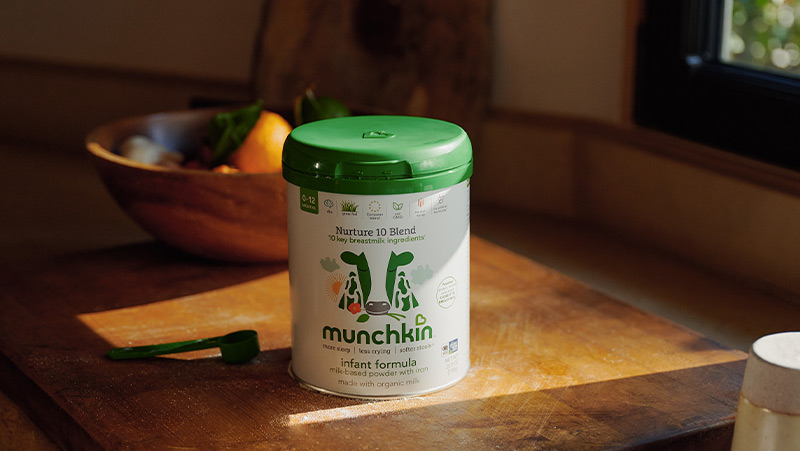
Munchkin Infant Formula with Organic Milk is a USDA-certified organic option for families who want organic dairy sourcing without treating the organic label as the only factor in their decision.
It meets several of the practical criteria discussed above:
- Made with USDA-certified organic milk sourced from grass-fed cows in New Zealand, according to Munchkin product information
- Non-GMO, a claim that applies to the Organic variant only
- Cow’s-milk-based and iron-fortified
- Lactose as the main carbohydrate
- Made without corn syrup
- Clean Label Project certified, according to current certification and permitted-use materials
- Manufactured in a facility represented by Munchkin as registered with FDA and inspected by FDA and CFIA as applicable
The formula also contains the Nurture 10 Blend, which includes 10 ingredients also found in breastmilk*, such as DHA, ARA, lutein, taurine, lactoferrin, and alpha-lactalbumin. These ingredients are included as part of the formula’s overall nutrient and ingredient profile. Their presence does not make formula equivalent to breastmilk or imply that the structure, levels, or function of these ingredients are the same as in breastmilk.
Munchkin also offers an Original Milk variant for families who do not require organic certification. Both options are formulated to provide complete infant nutrition, so the decision can reflect sourcing preferences, availability, and budget.
*Structure and levels differ from those in breastmilk.
What Is the Bottom Line on Organic Formula?
Organic formula may suit families who prioritize certified sourcing and production standards. Consider the complete formulation and your baby’s needs rather than relying on the organic label alone.
Both organic and conventional infant formulas can provide nutritionally adequate feeding when legally marketed in the United States and prepared as directed.
Frequently Asked Questions
Can you switch between organic and conventional formula?
Many babies can switch between comparable organic and conventional formulas, but acceptance and tolerance vary. Always use the scoop provided with the formula. Ask your pediatrician before switching if your baby uses a specialty formula or has persistent feeding symptoms.
Is European organic formula better than US organic formula?
European organic formula is not automatically better than formula sold in the United States. The regions follow different production, labeling, and formulation rules. Formula used in the US should be legally marketed in the United States and meet FDA requirements for infant nutrition and safety; parents should avoid products that are not legally marketed for US use.
Is organic formula easier for babies to digest?
Organic certification does not determine how easily a baby digests a formula. Tolerance may depend on the protein, fat blend, carbohydrate source, feeding volume, and the baby’s individual needs. Persistent gas, vomiting, constipation, or feeding discomfort should be discussed with a pediatrician.
Can organic formula be used for combination feeding?
Yes. Organic infant formula can be used for combination feeding when it is appropriate for your baby and prepared as directed. Parents who want to maintain breastmilk supply may wish to discuss feeding frequency and pumping with a pediatrician or lactation professional.
This article is for general informational and educational purposes only and is not intended as medical advice. Breastfeeding is recommended as the best source of nutrition for most infants. All infant formulas legally marketed in the United States, organic and conventional, must meet FDA requirements for safety and nutrition. Choosing organic is a personal, values-based decision and is not required for a healthy baby. Product claims should be reviewed against current labeling, substantiation, certification status, and permitted claim language before publication. Always consult your pediatrician about choosing or changing your baby's formula. Structure and levels of nutrients shared with breastmilk differ from those in breastmilk.
References
- U.S. Food and Drug Administration, Infant Formula Homepage - https://www.fda.gov/food/resources-you-food/infant-formula-homepage
- U.S. Department of Agriculture, Agricultural Marketing Service, Organic Standards - https://www.ams.usda.gov/grades-standards/organic-standards
- U.S. Department of Agriculture, Agricultural Marketing Service, National List of Allowed and Prohibited Substances - https://www.ams.usda.gov/rules-regulations/organic/national-list
- U.S. Department of Agriculture, Agricultural Marketing Service, Organic Labeling - https://www.ams.usda.gov/rules-regulations/organic/labeling
- U.S. Department of Agriculture, Agricultural Marketing Service, Organic Livestock and Dairy Standards - https://www.ams.usda.gov/grades-standards/organic-livestock-dairy
- U.S. Food and Drug Administration, Handling Infant Formula Safely: What You Need to Know - https://www.fda.gov/food/buy-store-serve-safe-food/handling-infant-formula-safely-what-you-need-know

Dayna Landry, RD
Registered Dietician Nutritionist