Goat Milk vs Cow Milk Formula: A Parent's Guide
16 min read
Published on 19 Aug 2026
Goat milk and cow milk infant formulas marketed in the U.S. are formulated to meet FDA nutrient and safety requirements, and neither is universally better than the other. The FDA sets strict standards for nutrients, safety, and manufacturing that every formula sold must meet. .
The two formula bases differ mainly in their protein, fat, and lactose profiles, and some babies may tolerate one better than the other. The right choice depends on your individual baby and is best discussed with your pediatrician.
If you have been reading about goat milk formula, you have probably seen it described as more natural for digestion, often by the companies that sell it. Some of those claims have real science behind them, and some are more marketing than medicine. This guide lays out the actual differences between the two, what the evidence does and does not show, and the safety facts that matter most, so you can make an informed choice rather than a nervous one.
Here is what we will cover: whether one is genuinely better, how the two compare side by side, what the main differences mean in practice, the safety points every parent should know, and how to think about which might suit your baby.
Is goat milk formula better than cow milk formula?
No, neither goat milk nor cow milk formula is better for every baby. Since 2024, the FDA has permitted marketing in the U.S. for new goat milk-based formulas that completed the required FDA premarket notification process.
The FDA does not approve individual infant formulas before marketing. Instead, manufacturers must notify the agency before introducing a new formula and provide information and assurances about its nutritional adequacy, safety, and manufacturing.
Goat milk formula is often marketed as gentler or easier to digest, and there are real compositional differences behind those claims. Some research suggests that differences in protein, fat, and lactose could make goat milk formula sit more comfortably with certain babies. But it is important to be clear-eyed: the evidence that goat milk formula is meaningfully easier to digest for most babies is still limited, and much of the strongest enthusiasm comes from the companies that sell it. Cow milk formula has been the standard base for decades and works well for the large majority of babies.
So the answer is not "goat is better" or "cow is better." Both can be appropriate options for healthy infants, with differences in composition that may matter to individual families and babies. Remember that it can take your baby one to two weeks to adjust to a new formula. If you have any concerns about your baby’s formula, get your pediatrician’s input before making a change.
Goat milk vs cow milk formula at a glance
Here is how the two compare. When legally marketed in the U.S., both types must meet applicable federal infant formula requirements. The differences below relate mainly to their composition.
|
Feature |
Cow milk formula |
Goat milk formula |
| Protein type | A mix of A1 and A2 beta-casein proteins | Predominantly A2 beta-casein protein |
| Protein digestion | Forms a firmer, larger curd that can take longer to break down | Forms a softer, smaller curd that can be broken down more quickly |
| Lactose | Present | Slightly less, but still present |
| Fat | More long-chain fatty acids | More medium-chain fatty acids |
| Prebiotics (oligosaccharides) | Present, often added | Naturally a little higher, and also added |
| Nutritionally complete | Yes | Yes |
| Must meet applicable U.S. federal infant formula requirements | Yes | Yes |
| Appropriate for infants with diagnosed cow milk protein allergy | No | No |
One row is worth flagging now because it surprises parents: goat milk-based infant formula is not appropriate for infants with diagnosed cow milk protein allergy. It is also worth knowing that neither plain goat milk nor plain cow milk is safe for a baby under one year. We come back to both of these in the safety section, because they matter more than any of the compositional differences above.
What are the main differences?
The differences between goat milk and cow milk formula come down to four things: the type of protein, the amount of lactose, the kind of fat, and the natural prebiotics. Here is what each one actually means, and what it does not.
Protein: A1 and A2 Beta-Casein
There is a single amino acid difference between the A1 and A2 variants of beta-casein, which alters how they are broken down. Cow milk naturally contains a mix of A1 and A2, while goat milk is naturally almost all A2. A2 protein is often described as gentler, and some babies may find the softer curd it forms in the stomach easier to handle. However, the evidence that A2 is meaningfully easier to digest for most babies is still limited. If the A2 protein is what appeals to you, there are also A2 cow milk formulas available, so goat is not the only way to get it.
Lactose
Goat milk formula has slightly less lactose than cow milk formula, but both contain it, and the difference is smaller than marketing sometimes implies. While this may come as a surprise, true lactose intolerance in babies is extremely rare, so most babies who seem gassy or fussy on formula are not actually reacting to the lactose. If a baby genuinely cannot digest lactose, a slightly-lower-lactose goat formula is not the answer; they would need a specialized low-lactose or lactose-free formula prescribed with a pediatrician's guidance.
Fat
Goat milk contains more medium-chain fatty acids than cow milk, which has more long-chain fatty acids. Medium-chain fats are absorbed a little more easily, and this is one of the reasons goat milk formula is described as being gentler. As with the protein, this is a real compositional difference, but how much it matters in practice for a healthy baby is not firmly established, and formula makers of both kinds adjust the fat blend to meet a baby's needs.
Prebiotics
Goat milk naturally contains more oligosaccharides, a type of prebiotic that supports gut bacteria and is also found in breastmilk.*. This is often highlighted as a goat milk advantage. In practice, though, the natural amount in goat milk is still far lower than in breastmilk, and both goat and cow milk formulas add prebiotics to make up the difference, so the real-world gap between a good cow formula and a good goat formula is narrower than it may seem.
*Structure and levels differ from those in breastmilk.
To pull it together, here is what each difference actually means in practice:
|
Difference |
Cow milk formula |
Goat milk formula |
What the evidence says |
| Protein | Mix of A1 and A2 | Predominantly A2 | A2 may be gentler for some babies; evidence is limited, and A2 cow milk formulas also exist |
| Lactose | Present | Slightly lower | Both contain lactose; true lactose intolerance in infants is extremely rare |
| Fat | More long-chain fats | More medium-chain fats | Medium-chain fats absorb a little more easily; how much this matters for a healthy baby is not firmly established |
| Prebiotics | Added | Naturally a little higher, and added | Both add prebiotics, so the real-world gap is small |
“Cow milk-based formula and goat milk-based formula are both great options for most babies! What matters most is that your baby is growing well and the formula you have chosen is reliably available and accessible to your family.” - Alexis Berkovits, MD
Are goat and cow milk formula safe? What about the FDA?
Yes. Goat milk and cow milk infant formulas legally marketed in the U.S. must comply with federal requirements for nutritional adequacy, safety, manufacturing, and other aspects of infant formula production. Cow milk has been the standard formula base for decades, while commercial goat milk-based infant formula is newer to the U.S. market.
The FDA does not approve infant formulas before they are marketed. Manufacturers of new infant formulas must register with the FDA and submit a premarket notification with information related to the formula's composition, nutritional adequacy, safety, and manufacturing. The FDA reviews these submissions and can take regulatory action when a formula does not comply with applicable requirements.
During the 2022 infant formula shortage, the FDA exercised temporary enforcement discretion for certain imported formulas, including some goat milk-based products, to help increase supply. That temporary pathway was separate from the standard regulatory process for infant formulas marketed in the U.S. Some goat milk-based infant formulas have since completed the applicable FDA premarket notification process and other requirements for continued marketing in the U.S.
Goat milk-based and cow milk-based infant formulas marketed in the U.S. are subject to the same applicable federal infant formula requirements.
There are a few safety points that matter more than the compositional differences above, and they are worth reading carefully:
- Goat milk-based infant formula is not appropriate for infants with diagnosed cow milk protein allergy. Goat and cow milk proteins are highly similar and can cross-react, so goat milk formula should not be used as an alternative or trialed as an allergy-management strategy for CMPA without physician guidance. It is not a hypoallergenic formula. Infants with diagnosed CMPA may require a specialized formula, such as an extensively hydrolyzed or amino acid-based formula, selected with their pediatrician.
- Never give plain goat milk or plain cow milk to a baby under 12 months. Regular milk of any kind is not safe or nutritionally complete for young babies. Only fortified infant formula (or breastmilk) provides what a baby needs in the first year.
- Any switch made for a suspected allergy or intolerance should go through your pediatrician. Do not diagnose an allergy or switch formulas to treat one on your own. If you are concerned that your baby has a true food allergy, please schedule an appointment with your pediatrician for an evaluation.
If you are ever unsure whether your baby is tolerating their formula, your pediatrician is the right person to ask.
“Cow’s milk protein allergy is an immune reaction to proteins, like casein and whey, found in cow’s milk. It is the most common food allergy in early childhood, but the actual incidence rate is much lower than parents often suspect. The diagnosis and management of this condition should be done with your pediatrician because a specialized diet is required, and goat milk formula is not a safe option for these babies.” - Alexis Berkovits, MD
Which formula might be right for your baby?
For most healthy, full-term babies, a standard cow milk formula is the usual starting point, simply because it is well established, widely available, and works well for the majority of babies.
The American Academy of Pediatrics considers cow milk-based, soy-based, and goat milk-based infant formulas that meet applicable FDA requirements acceptable options for healthy infants who need formula. Goat milk formula can therefore be a legitimate option for healthy infants, but it is not automatically a better choice than cow milk formula.
Some parents consider goat milk formula if their baby seems uncomfortable on cow milk formula. But it is important to recall that symptoms like gas, fussiness, and spit-up are all extremely common in early infancy, and most of the time they are a normal part of a baby's developing digestive system rather than a sign that anything is wrong with the formula. Many babies who switch would have settled on their original formula given a little more time. That said, some babies genuinely do seem more comfortable on one formula base over the other, and if your pediatrician agrees it is worth trying, goat milk formula is a reasonable option to explore.
If you and your pediatrician do decide to change formulas, a few things help the transition go smoothly:
- Give it time. Allow a week or two before judging a new formula, since a baby's system needs time to adjust.
- Expect some short-term change. A little variation in stool or gas is normal while your baby settles into a new formula.
- Change one thing at a time. That way you can actually tell what is making a difference.
- Talk to your pediatrician first, not after. This matters most if you suspect an allergy or your baby has any medical concerns, since they can tell the difference between normal newborn digestion and something that requires an intervention.
A note on choosing a cow milk formula
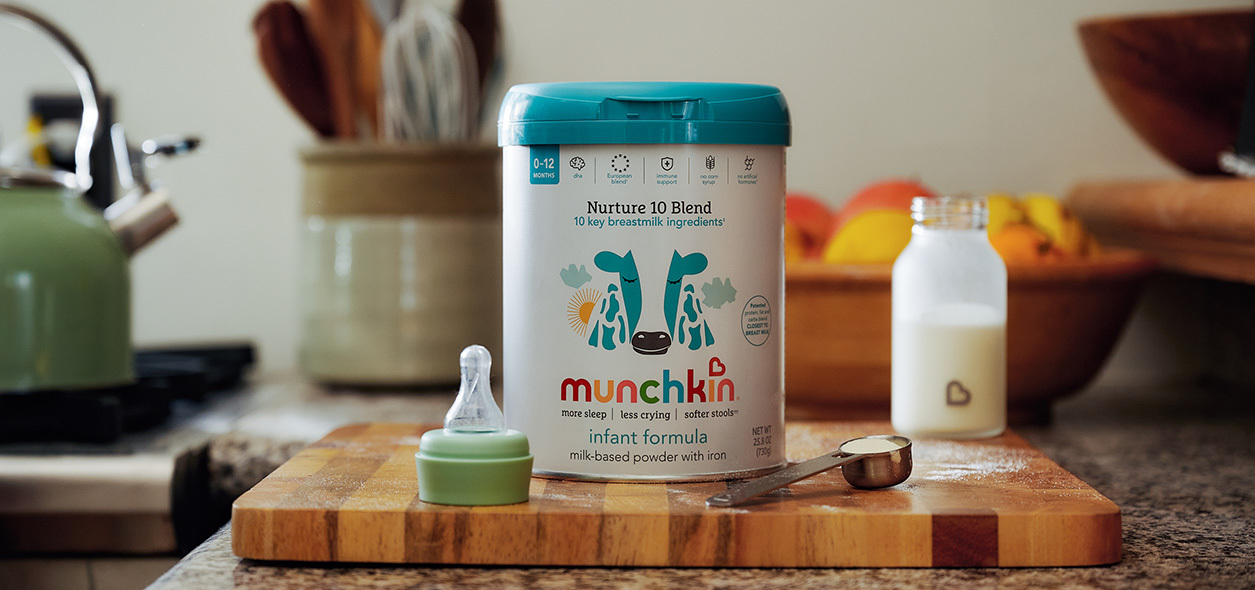
If you and your pediatrician decide that a cow milk formula is the right fit for your baby, it helps to know what to look for. A well-made cow milk formula is iron-fortified, uses lactose as its main carbohydrate, and includes the breastmilk-inspired nutrients that support your baby's development.* Munchkin Infant Formula is one thoughtfully made cow milk option built around those pillars, with a blend of nutrients also found in breastmilk.* If you want to dig into the details, our guides on how to choose a baby formula and what baby formula is made of walk through everything worth checking on a label.
*Structure and levels differ from those in breastmilk.
Frequently asked questions
Is goat milk formula more expensive than cow milk formula?
Usually, yes. Goat milk formula tends to cost more than standard cow milk formula, partly because goat milk is produced in smaller quantities and many goat formulas are sold as premium or imported products. Cost is worth factoring in, since the best formula is also one you can afford consistently, but it is not a measure of whether a formula is better for your baby.
Do cow milk and goat milk formula taste different?
Cow milk and goat milk formulas have distinct flavor profiles, but both are made to be acceptable to babies. Taste is rarely the deciding factor, and babies are generally far less particular about it than adults expect.
Can I make my own goat milk formula at home?
No. Homemade formula of any kind, goat or cow, is not safe for babies. The FDA and the American Academy of Pediatrics advise against it because homemade versions cannot reliably provide the precise, complete nutrition a baby needs and carry real risks of contamination and dangerous nutrient imbalances. Only use commercially manufactured infant formula that is legally marketed in the U.S. and meets applicable federal infant formula requirements.
Is goat milk formula closer to breastmilk than cow milk formula?
Not in any way that makes it a better substitute. Some components of goat milk, such as certain fats and prebiotics, are structurally similar to those in breastmilk, which is part of its appeal. Both goat and cow milk formulas are heavily modified and fortified to mirror breastmilk, but neither one matches it perfectly.*
*Structure and levels differ from those in breastmilk.
This article is for general informational and educational purposes only and is not intended as medical advice, and it is not a substitute for professional evaluation by your pediatrician or another qualified healthcare provider. Commercial goat milk and cow milk infant formulas marketed in the U.S. must meet applicable federal requirements for nutritional adequacy, safety, and manufacturing. The descriptions here are general guidance and cannot account for your individual baby. Decisions about which formula to use, and any decision to switch formulas, are best made with your pediatrician, especially if your baby has a suspected or diagnosed allergy, was born prematurely, or has any underlying health condition. Never feed plain goat milk or plain cow milk to a baby under 12 months. When in doubt about your baby's feeding or digestion, always reach out to your healthcare provider.
References
- U.S. Food and Drug Administration, Infant Formula Information for Parents and Caregivers — https://www.fda.gov/food/infant-formula-homepage/infant-formula-information-parents-caregivers
- Contemporary Pediatrics, Goat Milk-Based Infant Formula: What Pediatricians Need to Know — https://www.contemporarypediatrics.com/view/goat-milk-based-infant-formula-what-pediatricians-need-to-know
- Children's Hospital of Philadelphia (CHOP), Cow Milk Versus Goat Milk Formula — https://www.chop.edu/pediatric-health-chat/cow-milk-versus-goat-milk-formula
- American Academy of Pediatrics, HealthyChildren.org, Choosing an Infant Formula — https://www.healthychildren.org/English/ages-stages/baby/formula-feeding/Pages/choosing-an-infant-formula.aspx
- American Academy of Pediatrics, HealthyChildren.org, Why Formula Instead of Cow Milk — https://www.healthychildren.org/English/ages-stages/baby/formula-feeding/Pages/Why-Formula-Instead-of-Cows-Milk.aspx

Dr. Alexis Berkovits
Pediatrician