How to Choose Baby Formula: A Parent's Guide to Picking the Right One
11 min read
Published on 21 Jul 2026
To choose a baby formula, start with an iron-fortified, cow's milk-based formula that lists lactose as its main carbohydrate. That covers most healthy, full-term babies, and from there you adjust to your baby's needs with your pediatrician's help. There is no single best formula, and because every formula sold in the US has to meet the same FDA safety and nutrition standards, any can on the shelf will cover your baby's basic needs.
Standing in the formula aisle for the first time is a lot. Dozens of cans, each one promising something a little different, and all you really want is to know which one to grab. The good news: choosing well comes down to a short list of things that actually matter. The rest is just finding what your baby is happy with.
Here is the whole picture: whether there really is a best formula, what to look for on the label, how the different types and forms stack up, what actually sets one formula apart from another, and when it makes sense to switch.
How do you choose the right baby formula?
To choose the right baby formula, look for one that is iron-fortified, cow's milk-based, and lists lactose as its main carbohydrate, with added breastmilk-inspired nutrients and trusted third-party testing. Each of these is worth understanding, so here is what to look for and why it matters.
Iron-fortified
Iron is the one thing not to compromise on. The American Academy of Pediatrics recommends iron-fortified formula for all infants who are not breastfed, or who are only partially breastfed, from birth to one year of age. Babies are born with a store of iron that starts running low around four to six months, and formula is built to make up the difference. Iron supports healthy blood and brain development during the fastest stretch of growth, and iron-fortified formula has dramatically lowered rates of iron deficiency in infancy. Nearly all standard formulas sold in the US are iron-fortified, but it is always worth a quick check of the label to confirm.
Cow's milk-based to start
For most healthy, full-term babies, a standard cow's milk-based formula is the recommended starting point. The cow's milk in formula is heavily modified to make it safe and easy for a baby to digest: the protein is adjusted, extra lactose is added to match the level in breastmilk, and the butterfat is mostly swapped for vegetable oils a baby can absorb more easily. Cow's milk-based formulas are the most widely available and the most budget-friendly, which is a big part of why pediatricians usually suggest starting here unless your baby has a specific need.
Lactose as the main carbohydrate
Lactose is the natural sugar found in breastmilk, so a formula that lists it as the first carbohydrate is closest to what your baby would get from the breast. A lot of parents worry their baby cannot handle lactose, but true lactose intolerance in infants is very rare, since the ability to digest it is part of how babies are built. Some formulas use corn syrup or corn syrup solids instead, often in specialized or hydrolyzed products where the lactose has been reduced. Corn syrup solids are an FDA-permitted carbohydrate and are not the same thing as high-fructose corn syrup, but plenty of parents still prefer to see lactose listed first.
Breastmilk-inspired nutrients
Beyond the basics, look for the added ingredients that bring a formula closer to breastmilk.* The most common are DHA and ARA, the fatty acids that support brain and eye development, now found in nearly every modern formula. The better formulas go further, adding nutrients like alpha-lactalbumin and lactoferrin (gentle proteins found in breastmilk) and beta-palmitate (a fat structured the way it appears in breastmilk to help support digestion). The more of these a formula includes, the closer it comes to breastmilk, so this is often where the real difference between two formulas shows up.
Made for baby's age
Choose a formula made specifically for infants 0 to 12 months, and check that the label does not say toddler milk or toddler drink. Toddler formulas are not designed for young babies and often carry added sugars and a different nutrient balance. First-stage infant formula is suitable from birth and is the only formula most babies need through their first year.
Reliably available and within budget
A great formula is only great if you can actually keep your baby on it. Switching brands over and over can be harder on a baby's tummy than staying consistent, so it helps to choose a formula you can find easily and afford for the long haul, rather than the most premium option you can only buy now and then. Consistency tends to matter more than chasing the fanciest can.
Trusted third-party testing
Independent certifications are a useful extra layer of reassurance on top of the FDA's requirements. A certification like the Clean Label Project means a formula has been tested by an outside organization for contaminants such as heavy metals. Not every formula carries it, so seeing it on a label tells you the maker has chosen to be held to a higher standard of transparency.
What type of formula should you start with?
Most healthy, full-term babies do well starting on a standard cow's milk-based formula, so unless your pediatrician has advised otherwise, that is the usual place to begin. The cow's milk protein is modified to be gentler and easier to digest than plain cow's milk, and these formulas are the most widely available and budget-friendly option.
From there, the other types exist for specific needs rather than as upgrades:
- Sensitive or gentle formulas are often lower in lactose or use a whey-dominant protein blend that some babies find easier on the tummy.
- Hydrolyzed formulas have the protein broken down into smaller pieces. Partially hydrolyzed versions aim for general digestive comfort, while extensively hydrolyzed versions are used for cow's milk protein allergy under a pediatrician's care.
- Soy-based formula is the only plant-based option approved in the US and is chosen for specific dietary needs, usually with medical guidance.
- Goat milk-based formula is a newer US option some parents prefer, though it is not suitable for babies with a cow's milk allergy, since the proteins are similar.
- Amino acid-based formula uses the simplest form of protein and is reserved for severe allergies or medical conditions, always under a pediatrician's supervision.
If your baby is gassy, fussy, or spitting up, it is natural to wonder whether a different formula is the fix. Often it is not. These things are common in early infancy and frequently settle on their own, so it is worth checking with your pediatrician before switching. They can tell whether what you are seeing points to a real intolerance or is simply part of the newborn stage. For a closer look at what goes into each type, see our guide to what baby formula is made of.
Powder, concentrate, or ready-to-feed: which form is best?
All three forms of formula provide the same complete nutrition, so the best one comes down to your budget, your routine, and how much convenience matters to you. They differ mainly in price and prep:
- Powder is the most economical and the most widely used. You mix it with water per the label, and an opened can typically keeps for about a month.
- Concentrated liquid is a liquid you dilute with an equal amount of water. It sits in the middle on price and is a little quicker to prepare than powder.
- Ready-to-feed comes premixed and needs no water, which makes it the most convenient and the most reliably sterile option. It is also the most expensive, and once opened it has to be used more quickly.
A lot of families use powder day to day and keep a few ready-to-feed bottles on hand for travel, nighttime feeds, or the moments when convenience just wins. There is no nutritional downside to choosing based on what fits your life.
Is there a single best baby formula?
No. There is no single best baby formula, and no brand is right for every baby. The best formula is simply the one your baby tolerates well, that fits your budget, and that you can find reliably when you need it.
Now that you have seen the criteria and the different types, this is the part where you get to let the pressure go. Every infant formula sold in the US has to meet the same FDA standards for nutrition and safety, so one formula is not missing something essential that another one has. What changes from can to can is the finer detail: the type of protein, the carbohydrate source, and the added ingredients meant to bring it closer to breastmilk.* Babies are individuals, too, and the formula that suits one beautifully might not sit as well with another, even within the same family.
How Munchkin measures up on these criteria
If you are after a formula that checks the boxes above, Munchkin Infant Formula is built around them. It is iron-fortified and cow's milk-based, and it uses lactose as its main carbohydrate rather than corn syrup, so it stays close to the natural sugar in breastmilk.*
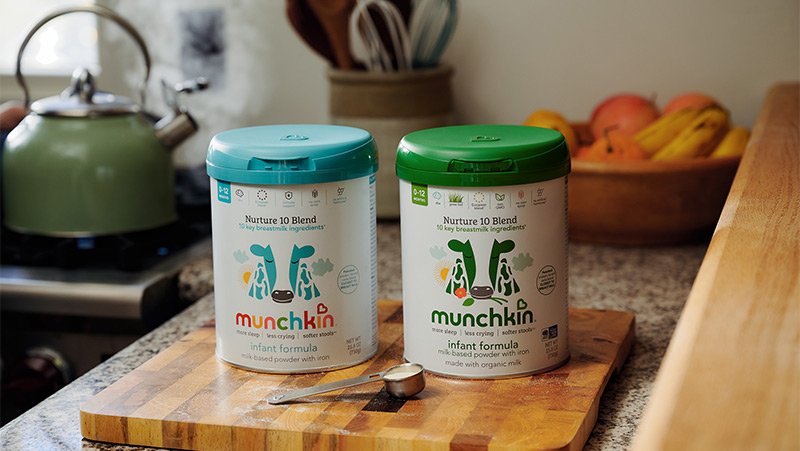
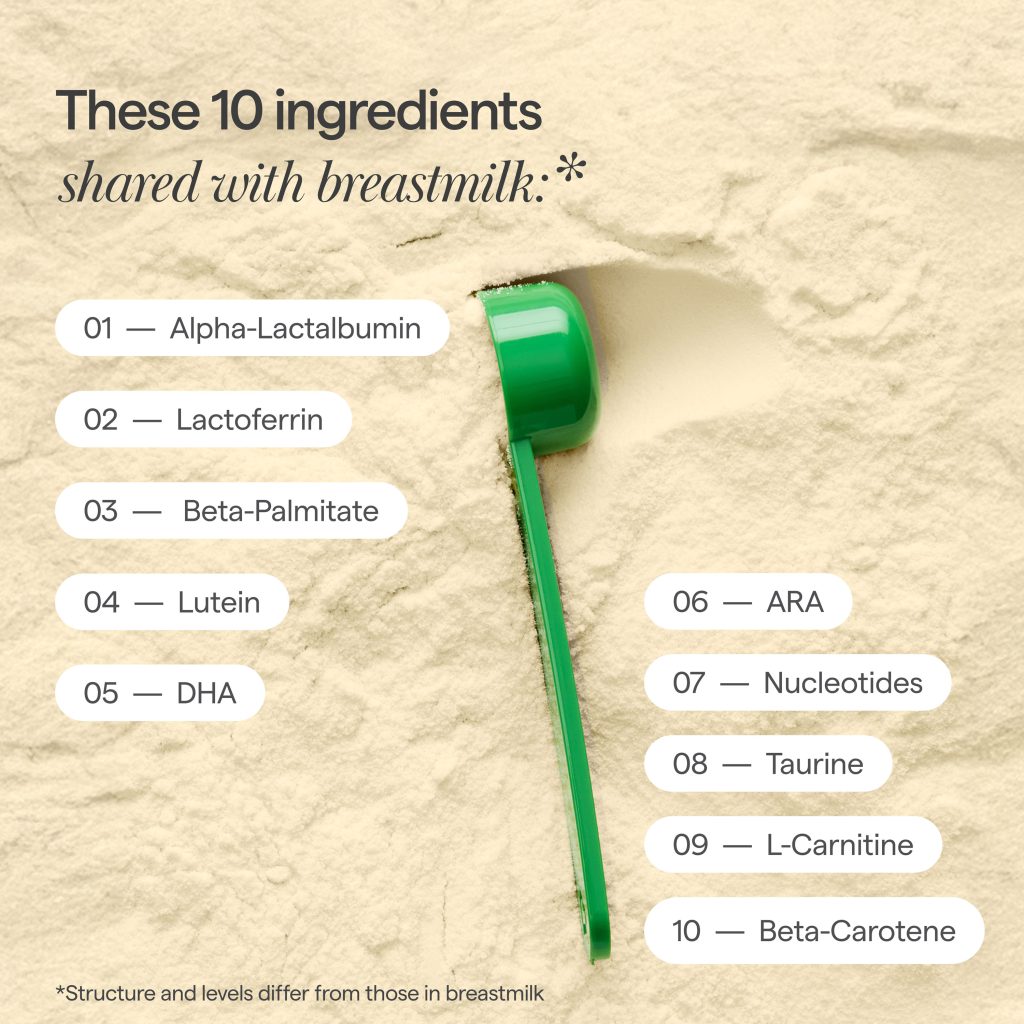
Where it goes further is in the added ingredients. Its patented Nurture 10 Blend shares 10 ingredients with breastmilk,* including DHA and ARA for brain and eye development, alpha-lactalbumin and lactoferrin (gentle, immune-supporting proteins found in breastmilk), and beta-palmitate, a fat structured the way it appears in breastmilk to help support digestion and nutrient absorption. It is the only US cow's milk formula made with beta-palmitate. Munchkin offers the blend in two options, Munchkin Infant Formula with Original Milk and Munchkin Infant Formula with Organic Milk, the latter made with USDA-certified organic milk from grass-fed New Zealand cows.
On the testing side, it is Clean Label Project certified, clinically studied with its formulation supported by a body of peer-reviewed research, and made in a facility audited by both the US FDA and the Canadian Food Inspection Agency, with every batch tested for heavy metals and pathogens. You can dig into the full clinical trial and ingredient science at Munchkin's Clinical Nutrition Hub. As with any formula, your pediatrician is the best person to confirm it is the right fit for your baby.
*Structure and levels differ from those in breastmilk.
Choosing with confidence
Choosing a formula is hard to get wrong when you start from the right place. An iron-fortified, cow's milk-based formula with lactose as its main carbohydrate suits most healthy, full-term babies, and from there it is about watching how your baby responds and adjusting if you need to. A formula your baby takes happily, that you can afford, and that you can find on the shelf when you need it is a formula that is working.
Lean on your pediatrician for the bigger questions, especially if your baby has allergies, reflux, or other medical needs. You know your baby, and that counts for a lot.
Frequently asked questions
Can you trust baby formula made in other countries?
The safest choice is a formula that meets US FDA standards, whether it is made in the US or abroad. Some imported or "European" formulas are popular with parents, but they are not all reviewed by the FDA and may have different labeling and preparation instructions. If you are considering one, talk to your pediatrician first.
Where should you buy baby formula?
Buy formula from trusted, established sellers: major retailers and big-box stores, pharmacies, grocery stores, or the brand's own website. The thing to avoid is unknown third-party resellers on online marketplaces, where formula may be expired, improperly stored, or counterfeit. Wherever you buy, check that the packaging is sealed and the use-by date is current before feeding.
How many calories are in baby formula?
Most prepared infant formula contains about 20 calories per fluid ounce, which is similar to breastmilk. This is true across nearly all standard formulas, so calorie content is rarely a reason to choose one formula over another unless your pediatrician recommends a higher-calorie formula for a specific medical reason.
Does my baby need a special formula?
Most healthy, full-term babies do not need a specialty formula and do well on a standard cow's milk-based one. Specialty formulas, such as hydrolyzed, soy, or amino acid-based, are for specific medical needs like allergies and should be used under a pediatrician's guidance rather than chosen on your own.
This article is for general informational and educational purposes only and is not intended as medical advice. Breastfeeding is recommended as the best source of nutrition for most infants. Always consult your pediatrician or a qualified healthcare professional before making decisions about your baby's feeding, including choosing or changing an infant formula. Structure and levels of ingredients shared with breastmilk differ from those in breastmilk.
References
- American Academy of Pediatrics, HealthyChildren.org, Choosing an Infant Formula — https://www.healthychildren.org/English/ages-stages/baby/formula-feeding/Pages/choosing-an-infant-formula.aspx
- American Academy of Pediatrics, Diagnosis and Prevention of Iron Deficiency and Iron-Deficiency Anemia in Infants and Young Children — https://publications.aap.org/pediatrics/article/126/5/1040/65343/Diagnosis-and-Prevention-of-Iron-Deficiency-and
- U.S. Food and Drug Administration, Infant Formula Information for Parents and Caregivers — https://www.fda.gov/food/infant-formula-homepage/infant-formula-information-parents-caregivers
- Centers for Disease Control and Prevention, Weaning (toddler milks not needed) — https://www.cdc.gov/infant-toddler-nutrition/breastfeeding/weaning.html
- Children's Hospital of Philadelphia (CHOP), Cow Milk Versus Goat Milk Formula — https://www.chop.edu/pediatric-health-chat/cow-milk-versus-goat-milk-formula
- Clean Label Project — https://cleanlabelproject.org/
Munchkin