How Long Is Formula Good For? Storage & Safety
12 min read
Published on 21 Jul 2026
Prepared baby formula is good for up to 2 hours at room temperature, or 1 hour once your baby starts drinking from the bottle. In the refrigerator, an untouched bottle of prepared powder formula keeps for up to 24 hours, while opened ready-to-feed formula and prepared liquid concentrate keep for up to 48 hours. An opened can of powder should be used within one month, and unopened formula lasts until the "use by" date printed on the container.
If you are standing there staring at a half-finished bottle, wondering whether it is still safe, you are in good company. Just about every formula-feeding parent has been there. The rules can feel fiddly at first, but they come down to a handful of numbers that turn into second nature fast.
Here is the full breakdown: exactly how long formula lasts in every situation, at room temperature, in the fridge, opened, and unopened, plus how to store it safely, how to tell when it has gone bad, and why the rules are different from breastmilk.
Baby formula storage times at a glance
Here is how long formula stays safe in every common situation. When in doubt, use the shorter time, and if you are ever unsure how long a bottle has been sitting, throw it out.
|
Situation |
How long it stays good |
Good to know |
| Prepared formula, room temperature, not yet fed | Up to 2 hours | Timed from when you prepared it |
| Prepared formula, after baby starts drinking | 1 hour | Then discard; bacteria from your baby's saliva grows in the bottle |
| Prepared powder formula, refrigerated, not yet fed | Up to 24 hours | Keep it covered or sealed |
| Opened ready-to-feed or prepared liquid concentrate, refrigerated | Up to 48 hours | Keep the container covered |
| Warmed bottle | 1 hour | Never re-warm a bottle |
| Opened can of powder | 1 month | Store cool and dry, not in the fridge |
| Unopened formula (any type) | Until the "use by" date | Store in a cool, dry place |
| Frozen formula | Not recommended | Freezing damages formula and does not extend its life |
The single most important rule to remember: once your baby has had a drink from a bottle, you have one hour to use it before it needs to go. Everything else is a little more forgiving, but that one is worth memorizing.
How long can formula sit out at room temperature?
Prepared formula can sit out at room temperature for up to 2 hours from the time you made it. Once your baby starts drinking, though, that window drops to 1 hour from the start of the feed, and anything left after that should be thrown away.
The reason for the two different limits comes down to bacteria. Freshly prepared formula that has not been touched has no new bacteria introduced to it, so you have a bit more time. But the moment your baby drinks, a small amount of saliva passes back into the bottle, and that saliva brings bacteria that multiply as the formula sits. Warmth speeds it up, which is why a used bottle has such a short safe window.
This is the rule that catches tired parents most often: the bottle that got started, set down, and forgotten for an hour and a half during a nap. If that happens, the safest move is to toss it and make a fresh one. Wasting a little formula stings, but a fresh bottle is always the safer choice, and you will waste less as you learn how much your baby actually takes in one sitting.
How long does formula last in the fridge, and can you make it ahead?
Prepared powder formula keeps in the refrigerator for up to 24 hours, as long as your baby has not yet had a drink from the bottle. Opened ready-to-feed formula and prepared liquid concentrate last a little longer, up to 48 hours refrigerated. Either way, keep the bottle or container covered, and store it toward the back of the fridge where it is coldest, not in the door.
One firm rule: never put a bottle back in the fridge once your baby has drunk from it. The saliva that gets in during feeding starts bacteria growing, and chilling it does not undo that, so a used bottle always goes in the sink, not back in the fridge.
Making formula ahead of time is not only allowed, it is one of the easiest ways to save yourself stress at 2am. To batch a day's worth safely:
- Prepare the formula, then pour it into clean bottles or a covered formula pitcher.
- Label each bottle with the date and time you made it.
- Keep your fridge at 40°F (4°C) or colder.
- Use any prepared formula within 24 hours, counting from when you made it, and toss whatever is left.
Prepping ahead means a crying, hungry baby does not have to wait while you measure and mix. It is a small thing that makes a real difference on a hard night.
How long do opened and unopened cans of formula last?
An opened can of powder formula should be used within one month of opening it. Store it in a cool, dry place with the lid tightly closed, and do not keep it in the refrigerator, since moisture and cold can affect the powder. Unopened formula lasts until the "use by" date printed on the container, which is usually somewhere between 12 and 24 months from when it was made.
The "use by" date is not a soft suggestion. The FDA requires it on every container of infant formula because it marks how long the formula is guaranteed to hold its full nutrition and quality. Never use formula past that date, even if it looks and smells fine, because its nutrient levels can drop over time.
A simple habit helps here: when you open a new can, write the date on the lid. That way you always know at a glance whether you are still inside the one-month window, without having to remember when you started it.
Can you freeze or reheat baby formula?
No, you should not freeze baby formula. Freezing does not extend how long it lasts, and it can make the formula separate and lose quality, so there is nothing to gain and something to lose. This is one of the places where formula and breastmilk differ, since breastmilk can be frozen, and it catches a lot of parents by surprise when they move from the breast to the bottle.
Reheating is limited too. A warmed bottle should be used within one hour, and you should not warm it more than once. If your baby did not finish a warmed bottle, discard the rest rather than saving it to reheat later. When you do warm a bottle, stand it in a bowl of warm water or use a bottle warmer, and never use the microwave, which heats unevenly and creates hot spots that can burn your baby's mouth.
Formula does not actually need to be warmed at all. Plenty of babies are perfectly happy with room-temperature or even cool formula straight from the fridge, so if warming is becoming a hassle, you can just skip it.
How can you tell if formula has gone bad?
The clearest way to know formula has gone bad is by the clock: if a bottle has been out or stored longer than the safe times above, treat it as spoiled even if it seems fine. Beyond timing, a few signs point to formula you should not use:
- A sour or off smell when you open the bottle or can
- Clumps that will not dissolve or an unusual, gritty texture
- Separation or curdling that will not mix back together with a gentle swirl
- Any discoloration or a change from the usual appearance
Trust your senses, and when you are genuinely unsure, throw it out. Formula is cheap compared with a sick baby, and a fresh bottle is always the safer call. This goes double for very young, premature, or immunocompromised babies, whose systems are less able to handle any bacteria, so err on the side of caution with them every time.
Why formula storage rules differ from breastmilk
Formula and breastmilk follow different storage rules, and formula's are shorter. If you are moving from breastfeeding to the bottle, or doing both, this catches a lot of parents off guard, because the timelines you learned for pumped milk do not carry over to formula.
The difference comes down to what is in each one. Breastmilk contains natural components that help slow bacterial growth, which is why it can be stored longer and even frozen for later. Formula does not have those properties, so it relies entirely on careful handling and shorter time limits to stay safe. It is not that one is better than the other. They simply behave differently once they are out of the container, and the rules reflect that.
So if you combination feed, keep the two sets of guidelines separate in your head. When in doubt about a bottle, follow whichever rule is stricter, and you will always be on the safe side.
A quick word on preparing formula safely
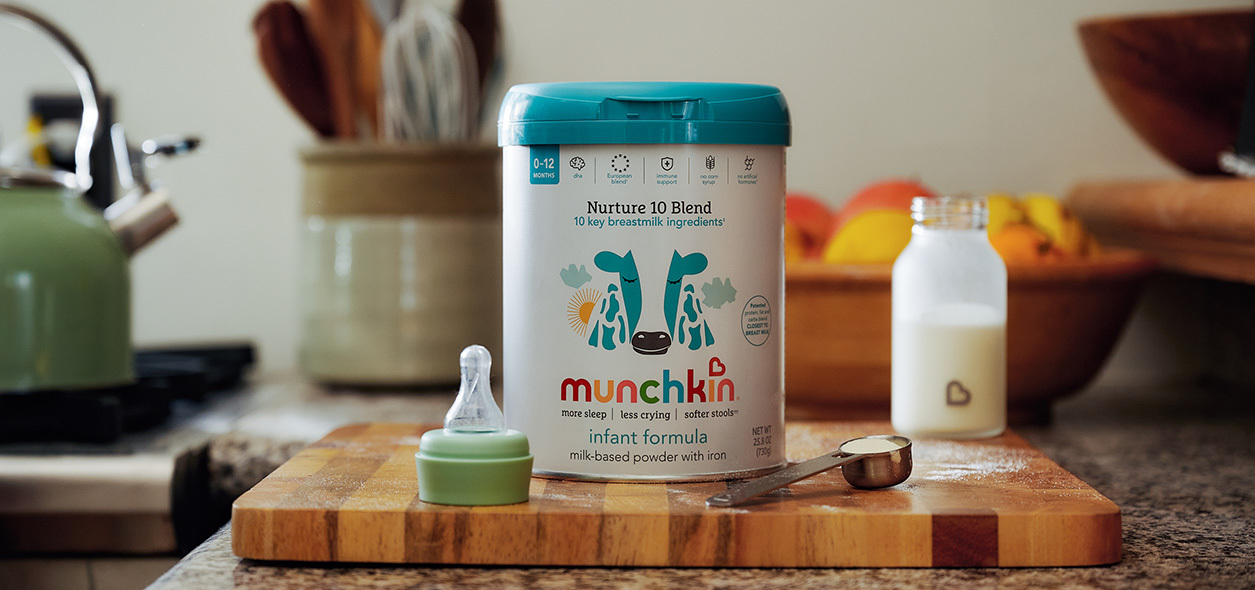
Storing formula correctly is only half the picture. Preparing it correctly matters just as much. Always follow the exact mixing instructions on your formula's label, and never add extra water to stretch a can further, since over-diluted formula does not give your baby enough nutrition and can be genuinely dangerous. Measure carefully every time, and use safe water to mix it. If you use Munchkin Infant Formula, the mixing instructions are printed right on the can.
Frequently asked questions
How should you store formula while traveling or on the go?
Carry pre-measured powder and clean water separately, then mix a fresh bottle when your baby is hungry, since prepared formula only lasts a couple of hours out of the fridge. If you need to bring a prepared bottle, keep it cold in an insulated bag with an ice pack, and use it within the usual time limits once it is no longer cold. Ready-to-feed formula is especially handy for travel because it needs no water and no mixing.
Can you use formula that was left out overnight?
No. Any prepared formula left at room temperature for more than 2 hours should be thrown away, so a bottle left out overnight is not safe to use, even if it looks fine. Bacteria can multiply to unsafe levels well before there is any visible or smellable sign, so go by the clock, not by appearance.
Does warm formula spoil faster than cold?
Yes. Warmth speeds up bacterial growth, which is why a warmed bottle has only a 1-hour window and why prepared formula should not sit out in a hot room or car. Keeping formula cold until you need it is one of the simplest ways to keep it safe for longer.
Is unopened formula safe to use right up to the expiration date?
Yes, as long as it has been stored properly in a cool, dry place and the container is undamaged. Unopened formula is good until the printed "use by" date, but once you open the can, the one-month clock starts regardless of how far away that printed date is.
This article is for general informational and educational purposes only and is not intended as medical advice. Always follow the preparation and storage instructions on your formula's label and the "use by" date on the container. When in doubt about whether formula is still safe, throw it out. Consult your pediatrician or a qualified healthcare professional with questions about preparing and storing formula for your baby, especially if your baby was born prematurely, is younger than two months, or has a weakened immune system.
References
- Centers for Disease Control and Prevention, Infant Formula Preparation and Storage — https://www.cdc.gov/infant-toddler-nutrition/formula-feeding/preparation-and-storage.html
- U.S. Food and Drug Administration, Handling Infant Formula Safely: What You Need to Know — https://www.fda.gov/food/buy-store-serve-safe-food/handling-infant-formula-safely-what-you-need-know
- American Academy of Pediatrics / CDC, How to Prepare and Store Powdered Formula — https://publications.aap.org/neokit/white-paper-parent/23728/How-to-Prepare-and-Store-Powdered-Formula-CDC
- Nemours KidsHealth, Formula Feeding FAQs: Preparation and Storage — https://kidshealth.org/en/parents/formulafeed-storing.html
- Centers for Disease Control and Prevention, Preventing Cronobacter Infection in Infants — https://www.cdc.gov/cronobacter/prevention/index.html
Munchkin