Kendamil® vs Munchkin Formula: How to Compare
13 min read
Published on 15 Sept 2026
There is no single winner in a Kendamil® vs Munchkin comparison. Both Kendamil and Munchkin products legally marketed as infant formula in the United States must meet applicable US requirements for infant formula, including requirements related to nutrient composition, manufacturing, quality control, labeling, and safety. The better fit depends on your baby’s needs, your family’s priorities, and guidance from your pediatrician.
This guide provides a neutral Kendamil® and Munchkin comparison based on criteria you can verify. It does not rank either formula or claim that one is universally better.
What should you compare when choosing between infant formulas?
Start by comparing the carbohydrate, protein, and fat sources in each formula. Then review its added ingredients, certifications, preparation requirements, availability, and cost per prepared fluid ounce. No single ingredient, certification, or front-label claim can determine which formula will suit every baby.
The following framework shows how to compare Kendamil® and Munchkin without treating one product feature as a universal measure of quality.
|
Criterion |
Why it matters |
What to look for |
| Carbohydrate source | Carbohydrates provide much of the energy in infant formula. | Check whether the formula uses lactose, corn syrup solids, maltodextrin, or another carbohydrate source. |
| Protein source and type | Protein sources and processing methods can differ across formulas. | Review the milk source, whey and casein details, and whether the protein is intact or hydrolyzed. |
| Milk and fat base | Formulas may use whole milk, nonfat milk, whey, vegetable oils, milk fat, or a combination. | Read the full ingredient list without assuming that one type of milk or fat is better for every baby. |
| DHA, ARA, and other nutrients | US formulas share required nutrient standards but may differ in the amounts of certain nutrients and in other safe, suitable ingredients. | Review the nutrient panel and complete ingredient list rather than relying on one featured front-label ingredient. |
| Organic status and certifications | These may reflect sourcing, production, or testing standards that matter to your family. | Confirm which certifications apply to the exact formula variety you are considering. |
| Preparation and format | Mixing ratios, scoop sizes, packaging, and available formats affect daily use. | Follow the exact label instructions and consider how the product fits your feeding routine. |
| Value | Can price and package size do not show the full feeding cost. | Compare the cost per prepared fluid ounce using the mixing instructions on each label. |
| Availability | Reliable access can make it easier to maintain a consistent feeding routine. | Check local stock, online availability, subscription terms, and access while traveling. |
Use these criteria together. A featured ingredient, certification, package price, or milk source cannot show by itself which formula will suit an individual baby.
For a closer look at how carbohydrates, proteins, fats, and added ingredients appear on a formula label, see What Is Baby Formula Made Of?
Do Kendamil® and Munchkin meet the same US formula requirements?
Yes. Kendamil® and Munchkin products legally marketed as infant formula in the United States must meet applicable US requirements for infant formula. This includes requirements related to nutrient composition, manufacturing, quality control, labeling, and safety.
Infant-formula manufacturers must register with the FDA and notify the agency at least 90 days before marketing a new formula in the US. This process includes information about the formula’s nutrients, ingredients, manufacturing, and compliance with nutrient and quality requirements.
Meeting the same requirements does not mean the formulas have identical formulations. They may differ in their milk and fat sources, added ingredients, certifications, manufacturing locations, availability, and cost. Suitability can also vary by baby.
Ask your pediatrician for guidance if your baby was born prematurely, has a diagnosed allergy or medical condition, or needs a specialized formula.
What is Kendamil® Infant Formula?
Kendamil® is a British infant-formula brand with European-made cow’s-milk and goat-milk options for babies from birth through 12 months. Its formulas are imported to the United States and must meet applicable US infant-formula requirements to be sold there.
Its US range includes Classic, Organic, and Goat varieties. Each product has its own ingredient list and certifications, so review the label for the exact variety you are considering.
What is Kendamil Classic made with?
Kendamil® Classic is a powdered, cow’s-milk-based formula made with whole milk, reduced-minerals whey, lactose, skim milk powder, and a blend of sunflower, coconut, and rapeseed oils. Its whole-milk base provides naturally occurring milk fat globule membrane, or MFGM.
Lactose is its carbohydrate source. Kendamil®’s current US product information also lists plant-based DHA and ARA, nucleotides, and the prebiotics GOS and FOS. The ingredient list does not include corn syrup, palm oil, soy oil, or fish oil.
What Kendamil® formula options are available?
Kendamil® Organic follows a whole-milk and lactose-based approach using organic ingredients. The brand also offers a separate goat-milk formula made with whole goat milk, goat whey, lactose, vegetable oils, GOS, and plant-based DHA and ARA.
Milk source and organic certification may influence a family’s preferences. They do not indicate how an individual baby will tolerate a formula.
What does Munchkin Infant Formula offer across these criteria?
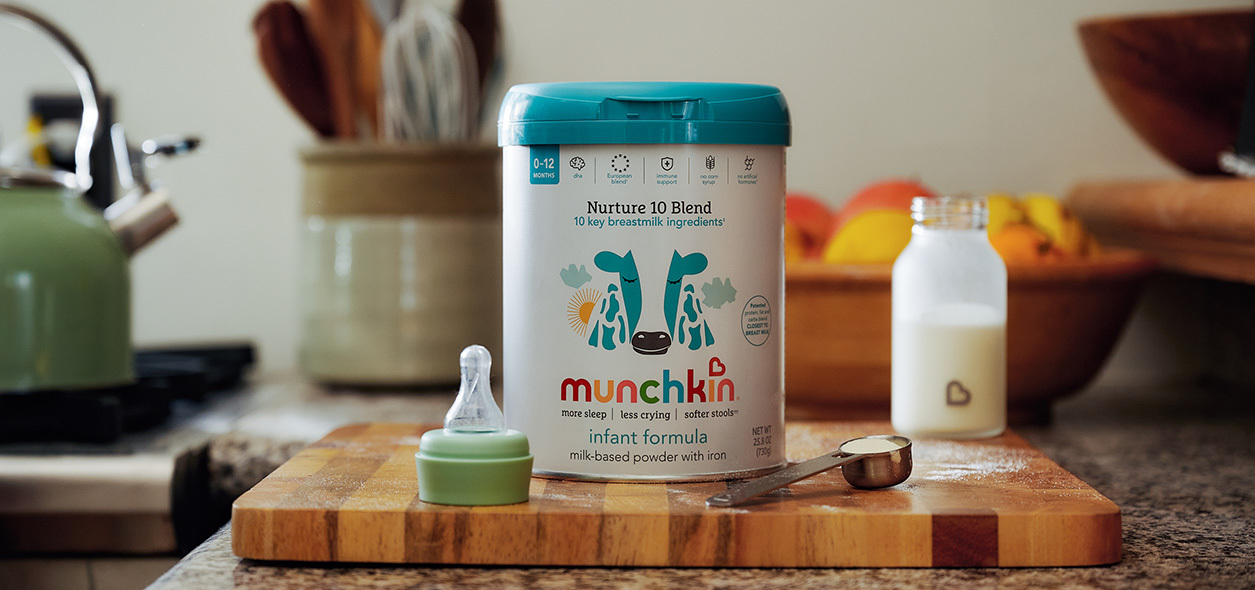
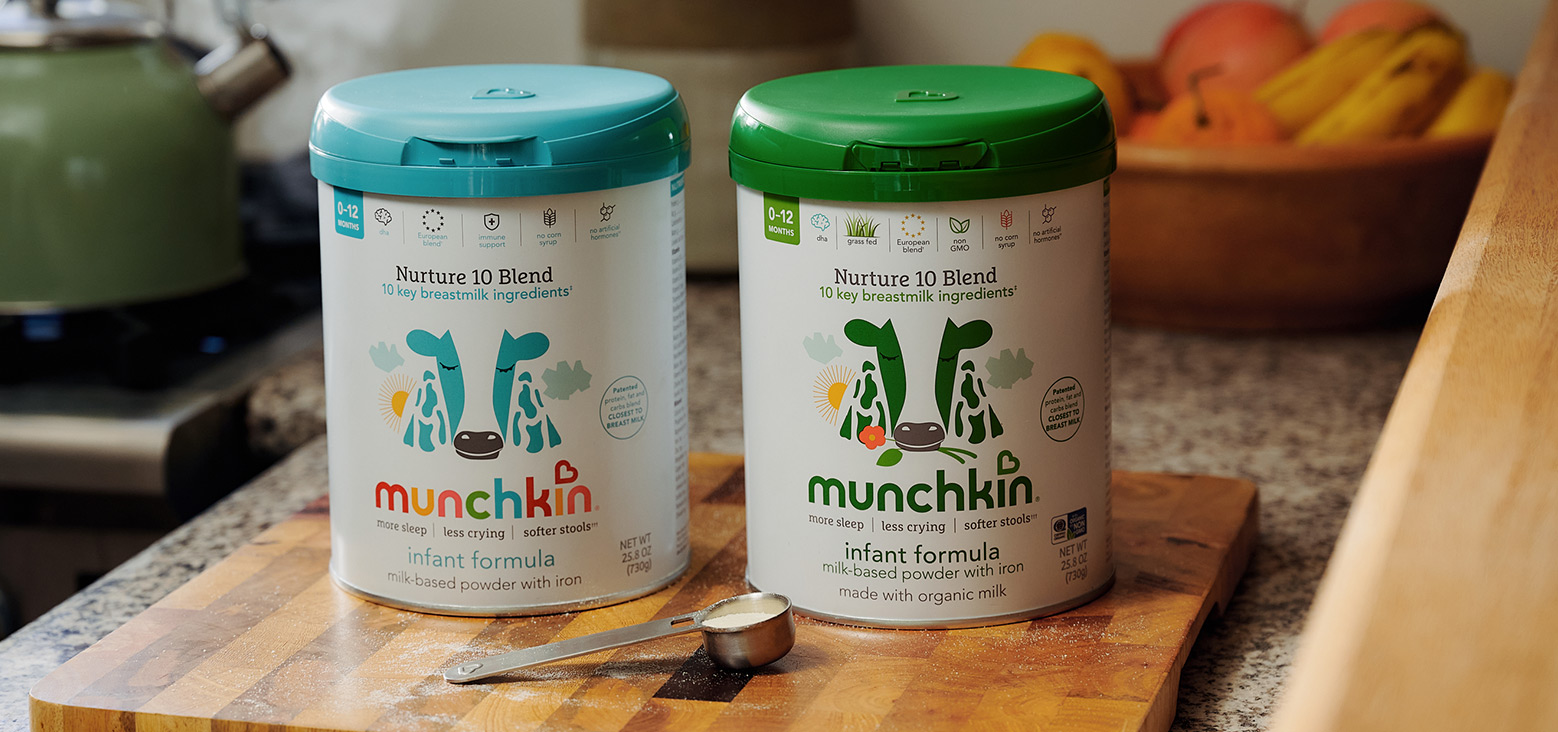
Munchkin Infant Formula is an iron-fortified, cow’s-milk-based powder for babies from birth through 12 months. It uses lactose as its main carbohydrate and is available in Made with Original Milk and Made with Organic Milk varieties. Both include the Nurture 10 Blend.
Munchkin’s formulation places particular emphasis on nutrients also present in breastmilk. Its patented Nurture 10 Blend brings together 10 such nutrients, including alpha-lactalbumin, lactoferrin, beta-palmitate, DHA, ARA, lutein, and nucleotides.
The products therefore differ in both their milk and fat sources and their overall ingredient profiles. Families can review the complete ingredient lists and nutrition information for each product when comparing them. (Kendamil® Classic; Munchkin® Made with Original Milk; Munchkin® Made with Organic Milk)
What are Munchkin’s milk, carbohydrate, protein, and fat sources?
Munchkin uses cow’s milk ingredients and lactose as its main carbohydrate rather than corn syrup. Made with Original Milk uses nonfat milk, demineralized whey, and a vegetable-oil blend. Made with Organic Milk uses organic nonfat milk, organic lactose, and a vegetable-oil blend. Review the current label for the full ingredient list.
The fat blend includes DHA and ARA, which help support brain and eye development. It also contains beta-palmitate, which is included to help support calcium absorption and softer stool consistency.
Kendamil®’s whole-milk base and Munchkin’s nonfat-milk-plus-oils approach are different formulation choices. Neither milk nor fat base is automatically more suitable for every baby.
What is the Nurture 10 Blend?
The Nurture 10 Blend is designed around 10 nutrients also found in breastmilk, making the breastmilk-inspired ingredient profile a central feature of Munchkin Infant Formula*. These include:
- Alpha-lactalbumin
- Lactoferrin
- Beta-palmitate
- Lutein
- DHA
- ARA
- Nucleotides
- Taurine
- L-carnitine
- Beta-carotene
The ingredients serve different roles in infant nutrition. DHA and ARA help support brain and eye development. Lutein helps support developing vision. Nucleotides help support cell growth, digestion, and natural immune function.
*Structure and levels differ from those in breastmilk.
What does “clinically studied” mean for Munchkin?
The Munchkin formulation was evaluated in a 16-week, randomized, controlled, double-blind clinical study involving 260 infants. The study assessed growth, formula acceptance, and gastrointestinal outcomes.
Babies fed the studied Munchkin formulation showed healthy growth, including equivalent weight gain and healthy head growth compared with the control formula. They also showed greater daily length gain, averaging 1.12 mm/day compared with 1.05 mm/day in the control group.
The study also reported less fussiness and gas than the control formula. Moderate gastrointestinal side effects were reported in 9.7% of the Munchkin group and 20.8% of the control group.
Kendamil® was not the control formula in this study. The findings therefore do not support a direct Kendamil® and Munchkin comparison, and individual results can vary.
What varieties, certifications, and purchase options does Munchkin offer?
Munchkin offers two powdered infant-formula varieties:
- Made with Original Milk: Made with nonfat milk and demineralized whey.
- Made with Organic Milk: Made with USDA Organic milk from grass-fed New Zealand cows.
The applicable organic and non-GMO claims apply only to the Organic variety. Both varieties currently carry Clean Label Project certifications and are manufactured in a purpose-built infant-nutrition facility in Canada that is fully registered and regularly inspected by the FDA and the Canadian Food Inspection Agency.
Munchkin Infant Formula is available through Target and Munchkin.com. Product availability, pricing, promotions, and subscription terms may change, so check the current product pages before purchasing.
To assess value, compare Munchkin’s current price per prepared fluid ounce using the mixing instructions on the label. Account for subscription savings, shipping, and limited-time offers separately because these terms can change.
How can you decide which formula fits your family?
When deciding between Kendamil® or Munchkin formula, begin with your baby’s medical and dietary needs. Then consider which product features matter to your household and how practical each formula will be to purchase and prepare consistently.
- Start with medical needs: Ask your pediatrician for guidance if your baby was born prematurely, has a diagnosed allergy, needs a specialized formula, has difficulty gaining weight, or shows persistent feeding concerns.
- Identify your family’s priorities: These may include organic certification, milk source, lactose as the main carbohydrate, added ingredients, third-party certifications, or where the formula is manufactured.
“Differences in how a baby responds to taste, stool pattern, or mild changes in feeding comfort can be part of normal adjustment to a formula. Poor weight gain, persistent vomiting, blood in the stool, hives, swelling, or significant feeding distress should be discussed with the pediatrician rather than managed by simply switching brands. Trouble breathing or facial or throat swelling requires urgent medical attention.”
Dayna Landry, MS, MPH, RD — Maternal and Infant Nutrition
- Compare practical factors: Check reliable availability, preparation instructions, package size, and cost per prepared fluid ounce.
- Follow the exact label and observe your baby’s response: Use the scoop and mixing ratio supplied with the product. Consider feeding comfort, intake, stool patterns, and growth with guidance from your pediatrician.
For more help, see How to Choose a Baby Formula and How to Switch Baby Formula Safely.
Frequently Asked Questions
Can you switch directly from Kendamil® to Munchkin?
Many babies using a standard cow’s-milk-based formula can change brands directly. Some families prefer a gradual transition if their baby needs time to adjust to a different taste or feeding routine.
Always prepare each formula according to its own label. Ask your pediatrician for guidance if your baby was born prematurely, uses a specialized formula, has a diagnosed allergy, or has ongoing feeding concerns.
Can you use a Kendamil® scoop to prepare Munchkin formula?
No. Use only the scoop supplied with the specific formula can. Scoop sizes and preparation instructions can differ between products.
Follow the water-to-powder ratio on the label. Using too much or too little powder can change the bottle’s nutrient and water balance.
Do Kendamil® and Munchkin use the same mixing ratio?
Do not assume that two formula products use interchangeable scoops or preparation instructions. Follow the water-to-powder ratio on the exact can you are using, and use only the scoop packaged with that formula.
Is Kendamil® Goat suitable for a baby with a cow’s-milk protein allergy?
No. Goat-milk infant formula is generally not appropriate for a baby with a diagnosed cow’s-milk protein allergy because of the high rate of cross-reactivity between the proteins. Ask your pediatrician about a suitable hypoallergenic or specialized formula.
and Munchkin, must meet applicable FDA requirements for infant formula. The right formula depends on your individual baby, and this article does not claim that any one formula is superior. Always consult your pediatrician about choosing or changing your baby's formula, especially if your baby was born prematurely or has any health condition.
Kendamil® is a registered trademark of Kendal Nutricare LTD. Munchkin is not affiliated with, endorsed by, or sponsored by Kendal Nutricare LTD or Kendamil®. References to Kendamil® in this article are made solely for identification and comparative purposes and do not imply endorsement or affiliation with Kendal Nutricare LTD.
References
- U.S. Food and Drug Administration, Infant Formula Homepage - https://www.fda.gov/food/resources-you-food/infant-formula-homepage
- Kendamil® USA, Organic Infant Formula 28.2 oz (0–12 Months) - https://us.kendamil.com/products/organic-first-infant-milk
- Kendamil® USA, Classic Infant Formula 28.2 oz (0–12 Months) - https://us.kendamil.com/products/classic-first-infant-milk
- U.S. Food and Drug Administration, Infant Formulas Marketed in the U.S. - https://www.fda.gov/food/infant-formula-homepage/infant-formulas-marketed-us

Dayna Landry, RD
Registered Dietician Nutritionist